IDIQ, GWAC, BPA, and BOA: contract vehicles explained
An IDIQ is a contract with a set time period but flexible quantities — the government orders what it needs, when it needs it, through individual task orders. A GWAC is a specific type of IDIQ reserved exclusively for information technology purchases, managed by an OMB-designated agency for use across the entire federal government. A BPA is a simplified standing agreement for repetitive purchases, like a tab at a store you visit regularly. A BOA pre-negotiates terms and conditions for future orders but isn’t actually a contract until the government places a specific order.
That’s the 30-second version. The rest of this article gives you the details you need to understand which vehicles you’ll encounter, how work flows through them, and where small businesses fit into each one.
If you’re still sorting out basic registration, start with the guide to registering for government contracts. Everything below assumes you have an active SAM.gov registration and understand how solicitations are structured.
Why contract vehicles exist
The federal government spends over $700 billion on contracts annually. Processing each purchase as a standalone competitive procurement would grind the system to a halt. Contract vehicles solve this by pre-qualifying a pool of contractors and establishing terms upfront, so individual purchases can happen faster with less paperwork.
Think of it like this: instead of running a full job posting every time a company needs a freelancer, the company maintains an approved vendor list. When a project comes up, they reach out to the pre-approved list and pick the best fit. Contract vehicles work the same way, except with federal regulations governing every step.
The four types covered here — IDIQ, GWAC, BPA, and BOA — each serve different purchasing situations. Some overlap. The terminology gets tangled. What follows is the plain English breakdown.
IDIQ: indefinite delivery, indefinite quantity
What it is
An IDIQ contract (FAR 16.504) establishes a framework: the government agrees to buy an indefinite quantity of supplies or services from one or more contractors during a fixed period, with deliveries ordered as needs arise. The contract sets a ceiling (maximum) and a floor (minimum guarantee), but the actual volume depends on how many task orders the government issues.
Plain English: IDIQ contract
An IDIQ is like a retainer agreement. You sign a contract saying “I’ll provide cybersecurity services at these rates for the next five years.” The government guarantees a minimum dollar amount (often small — sometimes as low as $2,500) and reserves the right to order up to a ceiling amount. Each piece of actual work arrives as a task order with its own scope, timeline, and budget.
Most IDIQs run five years: a base period plus four one-year options, though structures vary. The ordering period can extend longer depending on agency needs.
Single award vs. multiple award
An IDIQ can go to one contractor (single award) or multiple contractors (multiple award). Most large IDIQs are multiple award — the government selects, say, 15 contractors who all hold positions on the contract, then those 15 compete against each other for individual task orders.
Multiple award IDIQs use “fair opportunity” procedures under FAR 16.505(b). Every contract holder gets a fair shot at each task order, though how formal that competition is depends on the dollar value. A $50,000 task order might involve an email to all holders asking for a quick quote. A $10 million task order will look like a mini-procurement with its own evaluation criteria.
Real-world examples
The Navy’s SeaPort-NxG is a $50 billion multiple-award IDIQ for engineering and program management services. Over 2,000 companies hold positions on it, and small businesses represent roughly 85% of the awardees. The government uses it because they can issue a task order for a specific engineering support need and have qualified contractors competing within days, not months.
GSA’s OASIS+ covers professional services across multiple domains — management consulting, engineering, logistics, environmental. It’s structured with separate pools for small businesses and unrestricted competitors.
What small businesses need to know
Getting on an IDIQ is step one. Winning task orders is step two — and it’s where the real work happens. Having a position on a $50 billion contract means nothing if you never win a task order. Many small businesses celebrate the initial award and then discover the competition for actual work is fierce.
The protest rules are also different from standalone procurements. For task orders under $25 million (DoD, NASA, Coast Guard), you generally can’t protest to the GAO. You can raise concerns with the agency ombudsman required under FAR 16.505(b)(8), but your formal legal options are limited.
If you lack the past performance or team size to win an IDIQ slot on your own, teaming arrangements or joint ventures can fill capability gaps.
GWAC: governmentwide acquisition contract
What it is
A GWAC is a specialized type of IDIQ contract, but with two important restrictions: it’s only for information technology, and it must be operated by an executive agent designated by the Office of Management and Budget (FAR 2.101). That OMB designation is what makes it “governmentwide” — any federal agency can place orders through it without needing a separate interagency agreement under the Economy Act.
Plain English: GWAC
A GWAC is a pre-competed contract for IT products and services that any federal agency can buy from. Three agencies run most of them: GSA, NASA, and NIH. If the Army needs cloud migration services, instead of running their own year-long procurement, they can issue a task order through an existing GWAC and have a contractor working within weeks. The IT-only restriction is baked into the legal definition — if it’s not information technology, it’s not a GWAC.
The major GWACs you’ll encounter
OASIS+ (GSA) — The successor to the original OASIS contracts. Covers professional services including IT. Structured with separate small business and unrestricted pools. This is GSA’s flagship professional services vehicle.
SEWP VI (NASA) — Solutions for Enterprise-Wide Procurement. Primarily IT products (hardware, software, cloud), with some services. NASA runs it, but all federal agencies use it. Known for fast ordering — agencies can place orders in days.
CIO-SP3 (NIH/NITAAC) — Chief Information Officer - Solutions and Partners. IT services across 10 task areas. Has dedicated small business and 8(a) tracks. The planned successor, CIO-SP4, was cancelled in early 2026 after years of bid protests. CIO-SP3 has been extended through at least April 2027.
Alliant 2 (GSA) — Large-scale IT solutions. Both small business and unrestricted versions. Being evaluated for possible consolidation under GSA’s ongoing vehicle streamlining effort.
The consolidation wave
GSA is in the middle of a historic consolidation of IT contract vehicles, driven by a White House mandate requiring agencies to designate GSA as the executive agent for most common IT goods and services. Many agency-specific IDIQs are expected to quietly retire at their recompete dates and be replaced by GSA-managed vehicles like OASIS+.
For small businesses, this consolidation is a mixed bag. Fewer vehicles means fewer on-ramp opportunities to get your foot in the door. But it also means the vehicles that survive will carry more spending, making a position on them more valuable.
What small businesses need to know
Competing for a GWAC position requires a serious proposal. These are multi-year competitions with hundreds of applicants. You’ll need strong past performance, relevant certifications, and often a capability statement that demonstrates deep IT expertise.
The upside: once you’re on a GWAC, you’re competing for task orders against a pre-qualified pool rather than the entire market. The buying agency has already decided to use that vehicle, so the only question is which contract holder gets the work.
If you can’t win a GWAC slot directly, subcontracting under a prime who holds one is a legitimate path. The guide to finding subcontracting work covers how to identify primes with GWAC positions who need small business teammates to meet their subcontracting goals.
BPA: blanket purchase agreement
What it is
A BPA (FAR 13.303) is a simplified agreement between a government buyer and a contractor to fill repetitive needs for supplies or services. It’s the government equivalent of a standing order at a supplier — the buyer and seller agree on pricing and terms, and then individual purchases (“calls”) happen without a new competitive process each time.
Plain English: BPA
A BPA is like having an account at a hardware store. You and the store agree on pricing for the things you buy regularly. When you need something, you call and place an order without negotiating from scratch. The government uses BPAs for recurring needs — office supplies, IT support, temporary staffing — where setting up a new contract every time would be wasteful.
BPAs are commonly established against existing contracts, particularly GSA Multiple Award Schedule (MAS) contracts. An agency identifies a Schedule contractor whose offerings match their recurring needs, negotiates BPA terms (which can include better pricing than the base Schedule), and starts ordering.
How BPAs differ from IDIQs
The distinction trips people up because both involve placing orders against a pre-established agreement. The key differences:
| Feature | BPA | IDIQ |
|---|---|---|
| Is it a contract? | No. It’s an agreement to streamline future purchases | Yes. It’s a binding contract with minimum/maximum quantities |
| Minimum guarantee | None. The government can establish a BPA and never place an order | Required. IDIQs must have a minimum quantity or dollar amount |
| Typical dollar range | Often used for purchases under the simplified acquisition threshold ($350,000) | No upper limit. Can reach billions |
| Competition | Can be sole-source for individual calls, but agencies must establish BPAs competitively among Schedule holders | Fair opportunity required for each task order on multiple-award IDIQs |
| Duration | Typically annual, renewed yearly. No longer than five years for Schedule BPAs | Five to ten years with base period plus options |
What small businesses need to know
BPAs are one of the most accessible entry points for small businesses because they’re often established at the local level by individual contracting offices. A base-level contracting officer who buys IT support services monthly might set up a BPA with a local small business rather than routing every purchase through a large IDIQ.
The catch: you generally need a GSA Schedule contract first. Most BPAs are established against Schedule contracts, so getting on a GSA Schedule is the prerequisite. Without one, your BPA opportunities are limited to standalone BPAs under FAR Part 13, which are less common.
Agencies can and do set aside BPAs for small businesses. If a contracting officer finds three or more small businesses on the GSA Schedule who can provide what they need, they can restrict the BPA to small business competitors only.
BOA: basic ordering agreement
What it is
A BOA (FAR 16.703) pre-negotiates terms, conditions, and pricing methods for future orders, but it is not a contract. That last part is critical and the source of most confusion. A BOA is a written understanding between a buyer and seller that says: “When we need to buy something from you, here’s how it will work.” Each individual order placed against the BOA is its own separate contract, evaluated and funded independently.
Plain English: BOA
A BOA is a handshake framework. You and the government agree on the rules of the road — labor rates, delivery terms, quality standards, which FAR clauses apply. But nobody owes anybody anything until an actual order gets placed. Each order goes through its own approval and funding process. The BOA just saves time by not renegotiating the basic terms every time.
Where BOAs show up
BOAs are most common in Department of Defense procurement, particularly for spare parts, maintenance components, and specialized equipment where the government knows it will need items from a specific manufacturer but can’t predict exactly when or how many. The Defense Logistics Agency (DLA) uses BOAs extensively for managing the military supply chain.
You’ll also see BOAs in situations where the items are proprietary — if only one company makes the replacement part for a specific weapons system, a BOA with that company lets the government order parts quickly without running a competition that only one company could win anyway.
How BOAs differ from BPAs and IDIQs
| Feature | BOA | BPA | IDIQ |
|---|---|---|---|
| Is it a contract? | No | No | Yes |
| Minimum guarantee | None | None | Required |
| Each order is a separate contract? | Yes | No (calls, not contracts) | No (task orders under one contract) |
| Funds obligated at signing? | No | No | Yes, at least the minimum guarantee |
| Most common use | DoD spare parts, proprietary equipment | Recurring commercial services, office supplies | Large-scale services, IT, professional support |
| Governed by | FAR 16.703 | FAR 13.303 (or FAR 8.405-3 for Schedule BPAs) | FAR 16.504 |
The practical difference: with an IDIQ, the government has committed to buying at least something from you. With a BOA, they’ve committed to nothing. They’ve just agreed that if they buy from you, these are the terms.
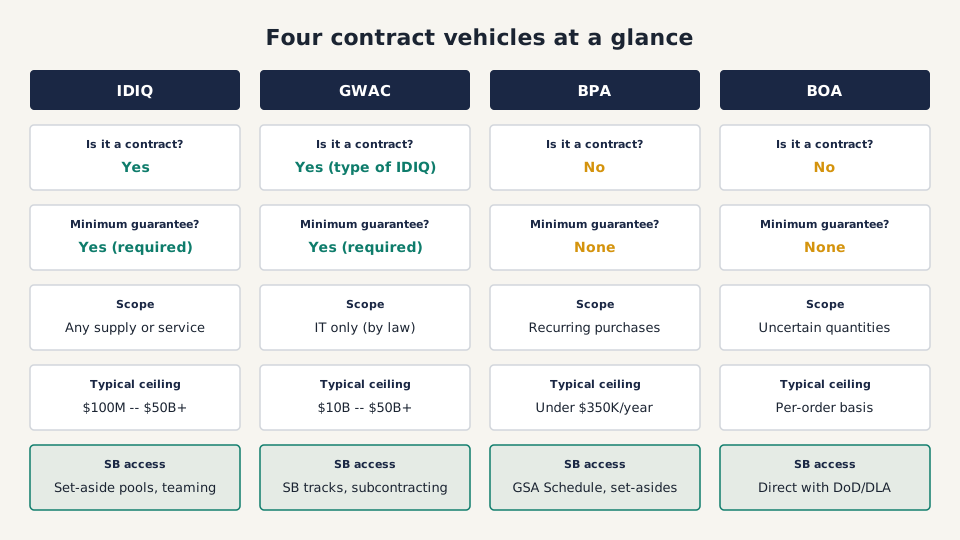
Which vehicle matters for your business?
Not all four of these are equally relevant to every small business. Here’s a rough decision framework:
If you sell IT products or services: GWACs and IT-focused IDIQs are your primary targets. Get on a GSA Schedule first, then use that as a platform to pursue BPAs and GWAC task orders. Watch the GSA consolidation announcements — the vehicles that survive will be where the spending concentrates.
If you sell professional services (non-IT): IDIQs like OASIS+ and agency-specific vehicles are your lane. BPAs can supplement with smaller recurring engagements.
If you manufacture products or sell specialized equipment: BOAs may be relevant, particularly if you supply DoD. BPAs work for commercial off-the-shelf items with recurring demand.
If you’re brand new to government contracting: Start with BPAs. They’re the smallest, most accessible vehicle type. Get a GSA Schedule, build a relationship with a local contracting office, and let BPA experience build your past performance for larger vehicles later.
Your first contract vehicle doesn’t need to be a $50 billion GWAC. A single BPA with a military installation near you can generate steady revenue and the past performance references you need to compete for larger vehicles. Many successful government contractors started with one local BPA and grew from there. The first 30 days checklist maps out this progression.
The acronym that matters most: task order
Regardless of which vehicle you’re working under, the unit of actual work in government contracting is the task order (or delivery order for products). The vehicle is just the highway. The task order is the destination.
Your capability statement needs to speak to specific task order requirements, not just general contract vehicle categories. Your proposal structure needs to address individual task order evaluation criteria. And your pricing needs to be competitive at the task order level, where you’re up against other pre-qualified contractors who all cleared the same bar you did.
If you hold a position on an IDIQ or GWAC and aren’t winning task orders, the problem isn’t the vehicle. It’s your capture strategy. Responding to sources sought notices early, building relationships with program managers before requirements hit the street, and teaming with complementary firms are what turn a contract vehicle position into revenue.
Your next step: if you don’t have a GSA Schedule yet, that’s the foundation for most of these vehicles. If you do, start tracking task order opportunities on the vehicles where you hold positions and build a pipeline of the ones worth pursuing.