How to respond to a sources sought notice (with template)
A sources sought notice is the government doing market research. They’re asking one question: “Are there businesses out there that can do this work?” Your response isn’t a proposal. It’s a 3-5 page document proving you exist, you’re qualified, and you’re interested. You don’t quote a price. You don’t commit to anything. You show the contracting officer that capable vendors are out there — and that your company is one of them.
Most small businesses skip these entirely. They see “sources sought” on SAM.gov and scroll past it because it’s not an RFP. That’s a mistake. Responding to a sources sought notice is the lowest-risk, highest-impact thing you can do in government contracting. It costs you a few hours of work, and it can directly shape whether the eventual contract gets set aside for small business, how the requirements get written, and whether the contracting officer already knows your name when the RFP drops.
What a sources sought notice actually is
The government can’t just buy things. Before spending taxpayer money, contracting officers are required to conduct market research under FAR Part 10 to determine what’s available in the commercial marketplace. A sources sought notice is one of the primary tools they use to do that research.
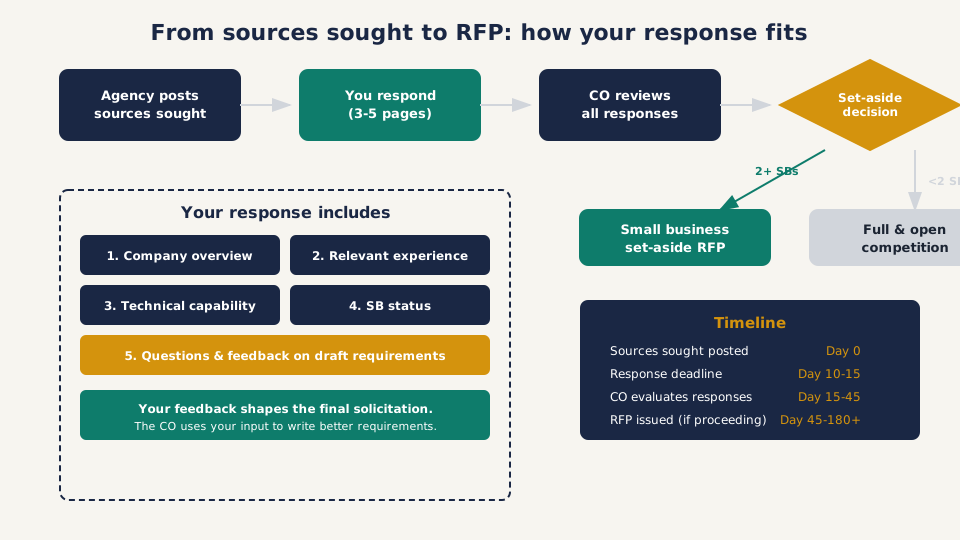
Here’s the practical sequence:
- An agency has a need — say, IT help desk support for a regional office.
- The contracting officer needs to figure out what kind of businesses can provide it, what it might cost, and whether there are enough small businesses to justify a set-aside.
- They post a sources sought notice on SAM.gov describing the requirement and asking interested businesses to respond.
- Based on the responses, the contracting officer decides the acquisition strategy: full and open competition, small business set-aside, 8(a) sole source, or something else entirely.
- Then they write the actual solicitation (the RFP or RFQ) and post it.
That middle step — where the contracting officer reads your response and decides what to do — is where your influence lives. If two or more small businesses respond and demonstrate they’re capable, that’s often enough to justify a small business set-aside. If nobody responds, the contracting officer assumes the market can’t support it and may issue the contract full and open, where your 15-person firm competes against Lockheed Martin.
Plain English translation
A sources sought notice is like a job posting that says “we’re thinking about hiring for this role — is anyone qualified and interested?” It’s not the actual job application. The agency uses the responses to decide if they should post the job, and what the requirements should look like. Your response is a quick pitch proving you could do the work if they move forward.
Sources sought vs. RFI: is there a difference?
You’ll see both “Sources Sought” and “Request for Information (RFI)” on SAM.gov, sometimes used interchangeably. Technically, a sources sought notice focuses on identifying capable vendors, while an RFI can ask broader questions about market conditions, pricing ranges, or technical approaches. In practice, they overlap heavily. Both are market research tools. Neither is a solicitation. Neither commits you to anything.
The response approach is the same for both: answer the questions they ask, demonstrate your capability, and make it easy for the contracting officer to check a box next to your company’s name.
Why most businesses get this wrong
The most common mistake is sending your generic capability statement and calling it a day. A capability statement is a one-page marketing document. A sources sought response is a tailored answer to specific questions the government asked.
Here’s the difference. A sources sought notice will typically say something like:
“The Government is seeking information from businesses that can provide cybersecurity assessment services in accordance with NIST SP 800-171. Interested parties should submit a response that includes: (1) company information, (2) relevant experience with similar work, (3) small business status, and (4) any questions or concerns about the draft requirements.”
If you respond with a generic “ABC Corp is a veteran-owned small business providing IT services to government and commercial clients,” you’ve wasted the contracting officer’s time. They asked four specific things. Answer all four.
The second most common mistake is treating the response like a full proposal. You don’t need 30 pages. You don’t need a cost breakdown. You don’t need past performance questionnaires. This is a conversation starter, not a contract bid. Keep it tight — 3 to 5 pages.
What to include in your response (template)
Every sources sought notice has different questions, so read the specific notice carefully and answer what they ask. But the vast majority follow a similar structure. Here’s a template you can adapt.
Section 1: company overview (half page)
This is where you prove you’re a real, registered, active business with the right credentials.
Include:
- Company name and legal entity type
- UEI number (from SAM.gov)
- CAGE code
- DUNS number (if the notice still references it — some older formats do)
- Primary NAICS codes relevant to this opportunity
- Small business size status and any certifications (8(a), WOSB, SDVOSB, HUBZone)
- SBA size standard under the listed NAICS code
- Point of contact: name, title, email, phone
- Company address
If you don’t have a CAGE code yet, the CAGE code guide covers how to get one. If your SAM.gov registration isn’t current, fix that first — the registration guide walks through the process.
Section 2: relevant experience (1-2 pages)
This is the core of your response. The contracting officer wants to know: has your company done work like this before?
For each relevant contract or project, include:
| Element | What to write |
|---|---|
| Client name | Agency or commercial client |
| Contract number (if federal) | Verifiable in FPDS |
| Period of performance | Start and end dates |
| Contract value | Dollar amount — shows you handle this scale |
| Scope of work | 2-3 sentences describing what you did, tied directly to the requirements in the sources sought |
| Your role | Prime contractor, subcontractor, or team lead |
| Outcome | One measurable result (on-time delivery rate, uptime percentage, cost savings) |
Include 2-3 examples. They don’t all have to be federal contracts. If you’ve done similar work for state governments or commercial clients, include those. The contracting officer is asking “can you do this work?” not “have you done this exact work for the federal government before?”
If you have federal past performance, use the same format as your past performance reference template. It saves you time and keeps your data consistent across responses.
Section 3: technical capability (1-2 pages)
Explain how you would approach the work described in the notice. You’re not writing a full technical proposal — you’re showing you understand the requirement and have a reasonable approach.
Cover:
- Your understanding of the requirement (restate it in your own words to show you read it)
- The approach or methodology you’d use
- Relevant tools, certifications, or clearances your team holds
- Key personnel who would work this contract (names and brief qualifications)
- Any relevant certifications (CMMC, ISO 27001, PMP, specific industry credentials)
Don’t get fancy. The contracting officer isn’t scoring this like a proposal. They’re reading it to determine if you’re a credible source. Clear and direct beats impressive-sounding but vague.
Section 4: small business status and socioeconomic categories
State clearly:
- Whether you qualify as a small business under the NAICS code in the notice
- What socioeconomic categories you fall under (8(a), WOSB, EDWOSB, SDVOSB, HUBZone)
- Whether you’re registered and active in SAM.gov
- Whether you’d be a prime contractor, or if you’d team with other businesses
This section matters because it directly feeds the contracting officer’s set-aside decision. If they get responses from two or more capable small businesses in a specific category, that can trigger a set-aside for that category. Your response literally creates the competition.
Section 5: questions and feedback on the draft requirements (optional but valuable)
Many sources sought notices include draft requirements or a preliminary statement of work and ask for industry feedback. If the notice asks for it, provide it. This is your chance to influence how the eventual solicitation gets written.
For example:
- “The draft SOW references NIST SP 800-171 Rev. 2, but NIST published Revision 3 in May 2024. We recommend the solicitation reference the current version.”
- “The requirement for all staff to hold TS/SCI clearances may limit small business participation. Consideration of Secret-level clearances for non-lead staff could broaden the competitive pool.”
- “The proposed period of performance of 6 months may be insufficient for the full assessment scope described. In our experience, comparable assessments typically require 9-12 months.”
This feedback is free consulting for the government, and it accomplishes something important: it positions you as the expert who understands the work deeply enough to spot issues in the requirements. When the RFP comes out, the contracting officer remembers who gave them useful feedback.
How to find sources sought notices on SAM.gov
Go to SAM.gov, click “Contract Opportunities,” and use the filters.
- Under “Notice Type,” select “Sources Sought” and/or “Special Notice” (some agencies post sources sought under special notices).
- Filter by your NAICS code.
- Set the “Posted Date” filter to the last 30 days.
- Optionally filter by set-aside type, agency, or place of performance.
You can also save this search and set up email notifications. SAM.gov will send you daily or weekly alerts when new opportunities matching your filters get posted. Set up notifications for both “Sources Sought” and “Special Notice” types to catch everything.
Response timelines: how long do you have?
Sources sought notices typically give you 10 to 15 calendar days to respond. Some agencies give as few as 7 days, others as many as 30. The deadline is stated in the notice.
There’s no FAR-mandated minimum response time for sources sought notices the way there is for formal solicitations (which require at least 15 days per FAR 5.203). The contracting officer sets the timeline based on urgency and complexity. In practice, most fall in that 10-15 day range.
Don’t wait until the last day. Contracting officers read responses as they come in. An early response gets more attention than one that arrives in a batch of 40 submissions on the deadline. If you have a template ready (see above), you can turn around a solid response in 2-3 days.
What happens after you respond
Your response goes to the contracting officer and the technical evaluation team. They review it alongside every other response and make several decisions:
Is this a small business set-aside? If two or more small businesses demonstrated capability, the contracting officer has the basis to set aside the solicitation. Your response helps create opportunities for other small businesses too.
How should the requirements be written? Your feedback on the draft requirements may influence the final SOW or PWS. Contracting officers are required to use market research to inform their acquisition strategy — your response is that market research.
Who should we invite to industry days? Agencies often hold pre-solicitation conferences after the sources sought phase. Businesses that responded to the sources sought are first on the invitation list.
Will there even be a solicitation? Sometimes the responses reveal that nobody can meet the requirements as written, or that the price expectations are unrealistic. The agency may revise the requirement, delay the procurement, or cancel it entirely based on what they learn.
You won’t get scored. You won’t get an award. You won’t get a rejection letter. You’ll either see the eventual RFP show up on SAM.gov, or you won’t. The notice will reference the same requirement and often include the original sources sought notice number so you can connect the dots.
The strategic case for responding every time
Here’s why the time investment pays off, even when it feels like shouting into the void.
You build a relationship before the competition starts. By the time the RFP drops, the contracting officer already knows your company, your capabilities, and your approach. You’re not a stranger cold-bidding a 150-page solicitation. You’re a known entity that engaged early.
You influence the acquisition strategy. Your response to a sources sought notice can directly determine whether the contract is set aside for small business. If you don’t respond, the contracting officer may conclude that small businesses can’t do the work, and the set-aside disappears.
You get early intelligence. The sources sought notice tells you what the agency is planning to buy months before the RFP. That’s months of lead time to build your team, identify subcontractors, refine your approach, and get your pricing in order. When the RFP hits, you’re already halfway done.
It’s a low bar. A sources sought response is 3-5 pages. A full proposal is 50-200 pages with pricing, past performance volumes, and compliance matrices. Responding to a sources sought takes a fraction of the effort and positions you for the real thing.
Tip
Track every sources sought notice you respond to in a simple spreadsheet: notice number, agency, requirement summary, date submitted, and a column for “RFP issued?” Check back on SAM.gov every 60-90 days. Over time, you’ll see the pattern — which agencies follow through quickly, which ones take a year, and which requirements get restructured based on industry feedback.
Common mistakes to avoid
Sending a generic capability statement. The contracting officer asked specific questions. Answer them. Your capability statement can be an attachment, but it’s not a substitute for a tailored response.
Overwriting. This isn’t a proposal. Five pages max. The contracting officer is reading dozens of these. Respect their time.
Ignoring the questions about the draft requirements. When the notice asks “do you have questions or concerns about the attached requirements?” that’s not a formality. It’s the government asking you to help them write a better solicitation. Give real feedback.
Not responding because “it’s not a real opportunity.” It’s the precursor to a real opportunity. The businesses that respond to sources sought notices are the ones that know about the RFP first, have relationships with the contracting officer, and understand the requirements better than competitors who waited for the solicitation.
Forgetting your SAM.gov registration is expired. The contracting officer will check. If your registration is inactive, your response goes in the trash. Verify your SAM.gov registration is current before you respond to anything.
Your next move
Set up saved searches on SAM.gov for “Sources Sought” and “Special Notice” in your primary NAICS codes. When the next one hits your inbox, use the template above and get a response out within the first five days. You’re not committing to a contract. You’re raising your hand and saying “we can do this.” That’s all it takes to go from invisible to a known quantity.
Once you’re comfortable responding to sources sought notices, the next step is learning to read and respond to the full solicitation when the RFP follows. And if you need a structured approach to your first formal proposal, the bid proposal template breaks down every volume section by section.