Simplified acquisition procedures explained for small businesses
Simplified acquisition procedures (SAP) are the government’s streamlined buying process for contracts under $350,000. They require less paperwork from both the buyer and the seller, move faster than full-and-open competition, and have built-in preferences that favor small businesses. If you’re a small contractor looking for your first federal win, SAP contracts are where you should be looking.
That’s the quick version. Here’s how the system actually works, what changed in the 2025-2026 threshold increases, and how to position your business to win these contracts.
What “simplified” actually means
When the government buys something, the Federal Acquisition Regulation (FAR) dictates how they do it. For large contracts — think multi-million-dollar IT systems or construction projects — the process is extensive. Multiple evaluation volumes, formal negotiations, debriefings, protest rights, sometimes years from solicitation to award. That’s FAR Part 15, “Contracting by Negotiation.”
Simplified acquisition procedures exist because not everything the government buys needs that level of process. A $75,000 order for office furniture doesn’t need the same acquisition rigor as a $50 million weapons system. SAP strips out the overhead so the government can buy routine goods and services quickly, and so small businesses can compete without needing a proposal-writing team.
Plain English: simplified acquisition procedures
SAP is the government’s “fast lane” for buying things under a certain dollar amount. Instead of a formal Request for Proposal (RFP) requiring a multi-volume technical response, you might get a Request for Quotation (RFQ) where you submit a price and a brief capabilities summary. The contracting officer has more flexibility, the evaluation is less formal, and the whole process takes weeks instead of months.
The key distinction is flexibility. Under full FAR Part 15 procedures, contracting officers follow rigid rules about evaluation criteria, competitive range determinations, and discussions. Under SAP, the contracting officer has broad discretion. They can evaluate quotes however they see fit, contact vendors directly, and make award decisions without the same procedural overhead.
The dollar thresholds you need to know
SAP operates within specific dollar limits. These thresholds changed in October 2025 due to the five-year inflation adjustment required by 41 U.S.C. 1908, so make sure you’re working with the current numbers.
| Threshold | Previous amount | Current amount (Oct 2025) |
|---|---|---|
| Micro-purchase threshold (MPT) | $10,000 | $15,000 |
| Simplified acquisition threshold (SAT) | $250,000 | $350,000 |
| Commercial items (FAR 13.5) | $7.5 million | $9 million |
| Contingency operations (domestic) | $800,000 | $1 million |
| Contingency operations (overseas) | $1.5 million | $2 million |
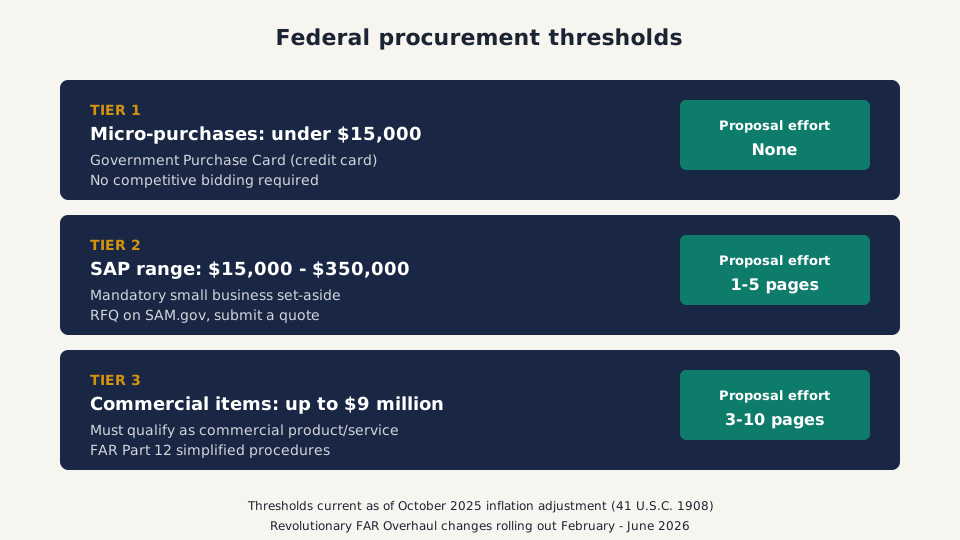
Three tiers matter for small businesses:
Under $15,000 (micro-purchases). The government can buy directly from any source using a Government Purchase Card (GPC) — essentially a government credit card. No competitive bidding required. The cardholder just needs to make sure the price is reasonable and rotate among vendors. If you sell commercial products or services under $15,000, you can get paid by credit card with zero proposal effort.
$15,000 to $350,000 (the SAP sweet spot). This is where simplified procedures shine. The government must set aside contracts in this range exclusively for small businesses unless the contracting officer determines there aren’t at least two capable small firms. That’s a mandatory small business set-aside for the entire SAP range. The solicitation is typically an RFQ posted on SAM.gov, and your response is a quote — not a formal proposal.
$350,000 to $9 million (commercial items). If what you’re selling qualifies as a “commercial product” or “commercial service” under FAR Part 12, the government can use simplified procedures for purchases up to $9 million. This is a big deal. It means a $2 million contract for commercial IT services can be awarded with the same streamlined process as a $200,000 office supply order.
How SAP contracts show up on SAM.gov
Most SAP opportunities are posted as combined synopses/solicitations on SAM.gov. A combined synopsis/solicitation is exactly what it sounds like — the notice that the government wants to buy something and the actual solicitation are packaged together in a single document, instead of being posted separately.
Here’s what to look for when you’re searching SAM.gov:
The notice type. SAP solicitations are typically posted as “Combined Synopsis/Solicitation” or “Solicitation.” Filter by these types to focus on SAP opportunities.
The NAICS code. Every solicitation lists a North American Industry Classification System code. Make sure the NAICS code matches your SAM.gov registration and your capability statement.
The set-aside type. Look for “Total Small Business Set-Aside” or set-asides matching your certifications (8(a), SDVOSB, WOSB, HUBZone). If you hold set-aside certifications, you’ll see opportunities with even less competition.
The response deadline. SAP solicitations typically give you 7-30 days to respond. That’s shorter than the 30-45 days common with full-and-open RFPs. Don’t let a good opportunity expire because you weren’t checking SAM.gov regularly.
Set up saved searches
Don’t rely on manually searching SAM.gov every day. Set up saved searches with your NAICS codes and preferred set-aside types. SAM.gov will email you when new opportunities match your criteria. That 7-day response window goes fast if you don’t see the posting until day 5.
How to respond to a SAP solicitation
Responding to a SAP solicitation is simpler than responding to a full RFP, but “simpler” doesn’t mean “sloppy.” The contracting officer still needs enough information to evaluate your quote and make an award decision.
A typical SAP response includes:
Your quote or price. This is straightforward. Provide the price for exactly what the solicitation asks for. Don’t add line items the government didn’t request. Match the CLIN (Contract Line Item Number) structure in the solicitation.
Technical capability. This isn’t a 50-page technical volume. It’s usually a brief description (1-5 pages) explaining that you can do the work. Reference specific experience. If you’ve done similar work before, say so with enough detail that the contracting officer can verify it.
Past performance. For SAP, past performance evaluation is informal. The contracting officer might check your references, look at your CPARS (Contractor Performance Assessment Reporting System) record, or simply accept your self-reported experience. Having a solid past performance reference package ready saves you time.
Reps and certs. Your representations and certifications from SAM.gov get pulled automatically. Make sure your SAM.gov registration is current and accurate. If it lapsed or has errors, your quote may get thrown out before the contracting officer even reads it.
The contracting officer evaluates quotes based on whatever criteria they stated in the solicitation. Under SAP, that evaluation can be as simple as “lowest price, technically acceptable” or a more nuanced best-value assessment. Read the solicitation carefully — it tells you how you’ll be evaluated.
The small business advantage in SAP
The FAR gives small businesses a structural advantage in the SAP range. FAR 19.502-2(a) requires that acquisitions between the micro-purchase threshold and the simplified acquisition threshold be set aside for small businesses when there’s a reasonable expectation that at least two responsible small businesses will submit competitive offers.
In practice, this means the vast majority of SAP contracts are small business set-asides. The contracting officer has to actively justify not setting a SAP contract aside for small businesses. That’s a high bar to clear, and most don’t bother trying.
This is why SAP contracts are the ideal starting point for new government contractors. You’re not competing against Lockheed Martin or Booz Allen. You’re competing against other small businesses. The playing field is level by design.
If you hold additional certifications — 8(a), SDVOSB, WOSB, or HUBZone — the advantage compounds. The contracting officer can further restrict competition to only certified firms in your category. An 8(a) sole-source award under SAP means you’re the only company submitting a quote. That’s about as close to a guaranteed win as government contracting gets.
The FAR overhaul: what’s changing right now
The federal government is in the middle of the most significant rewrite of the FAR in over 40 years. The Revolutionary FAR Overhaul (RFO), kicked off by an executive order on procurement reform, is restructuring how simplified acquisition procedures work. The first wave of changes took effect on February 1, 2026, with more rolling out through June 2026.
Here’s what matters for small businesses:
FAR Part 13 is splitting. Simplified procedures for commercial items have been moved from FAR Part 13 to FAR Part 12 (Acquisition of Commercial Products and Commercial Services). FAR Part 13 now covers “Simplified Procedures for Noncommercial Acquisitions” only. If you sell commercial products or services, your SAP procedures are now governed by FAR Part 12 — not Part 13.
Fewer clauses. The overhaul cut FAR Part 12 from 154 provisions and clauses down to 108. That’s less paperwork in your contracts, fewer compliance traps, and faster procurement cycles.
Higher ceilings. The commercial items simplified procedures ceiling jumped from $7.5 million to $9 million. That’s more contracts that can use the simplified process instead of the full FAR Part 15 machinery.
These changes are rolling out as class deviations, which means individual agencies are implementing them on slightly different timelines. If you’re responding to solicitations right now, read each one carefully. Some contracting officers are using the new FAR structure, and others are still on the old one. The solicitation itself tells you which version applies.
Common mistakes (and how to avoid them)
Treating SAP like a casual process. Yes, it’s simplified. No, that doesn’t mean the contracting officer will overlook a late submission or an incomplete quote. The rules are less formal, but they still exist. Submit on time, respond to every requirement in the solicitation, and format your quote professionally.
Ignoring micro-purchases. Contracts under $15,000 don’t require competitive bidding, which means the government can buy from you directly. If you sell commercial products, make sure government buyers know you exist. Get listed on commercial platforms, build relationships with local government offices, and make sure your SAM.gov profile is complete. The government spends billions annually on micro-purchases.
Only watching SAM.gov. SAM.gov is where most SAP solicitations land, but not all. Some agencies post on their own procurement portals. DoD uses the DoD Opportunities portal. Check agency-specific sites in addition to SAM.gov.
Not reading the solicitation. This sounds obvious, but it’s the most common failure point. The solicitation tells you exactly what to submit, how to format it, and when it’s due. Don’t submit a 30-page proposal when the solicitation asked for a 3-page capabilities statement. Don’t include pricing in your technical volume if the solicitation says to submit them separately. Read the instructions and follow them. If you need help understanding the structure of a government solicitation, start with how to read a government solicitation.
Submitting a price without checking the market. Under SAP, the contracting officer needs to determine that your price is “fair and reasonable.” If your quote is 40% higher than comparable commercial pricing, that’s a problem. Research what similar goods or services cost commercially, and price your quote accordingly. You don’t need to be the cheapest, but you need to be defensible.
Where SAP fits in your govcon strategy
If you’re new to government contracting, SAP contracts should be your first target. They’re smaller, faster, and designed for small businesses. You don’t need a proposal team. You don’t need bonding. You don’t need years of federal past performance. You need a solid capability statement, an active SAM.gov registration, and the discipline to check for opportunities and respond quickly.
Here’s a practical sequence:
- Get your SAM.gov registration and CAGE code squared away
- Build a capability statement that matches your target NAICS codes
- Set up saved searches on SAM.gov for your NAICS codes
- Respond to your first SAP solicitation — even if you don’t win, the experience of writing a quote teaches you how the process works
- Win a small SAP contract and execute it well
- Use that past performance to bid on larger opportunities
The beauty of SAP is that step 4 doesn’t take six weeks and $10,000 in proposal costs. It takes a few days and the cost of your own time. When the barrier to entry is that low, there’s no reason not to start.
If you’re already winning SAP contracts and want to move into larger opportunities, your next read should be how to respond to a sources sought notice. Sources sought notices are how agencies gauge market interest before issuing a formal solicitation, and responding to them gets your company on the contracting officer’s radar before the competition even starts.