Free capability statement template (with examples)
A capability statement is a one-page document that tells government contracting officers and prime contractors exactly what your business does, what you’ve done, and how to reach you. Think of it as your company’s resume for the federal marketplace. Contracting officers spend about six seconds on an initial scan before deciding whether to keep reading, so everything that matters needs to be on that single page.
If you’ve registered in SAM.gov and you’re wondering what comes next, this is it. You’ll hand this document to contracting officers at industry days, attach it to Sources Sought responses, email it to prime contractors, and upload it to your SBA profile. Without one, you’re invisible.
What goes on a capability statement
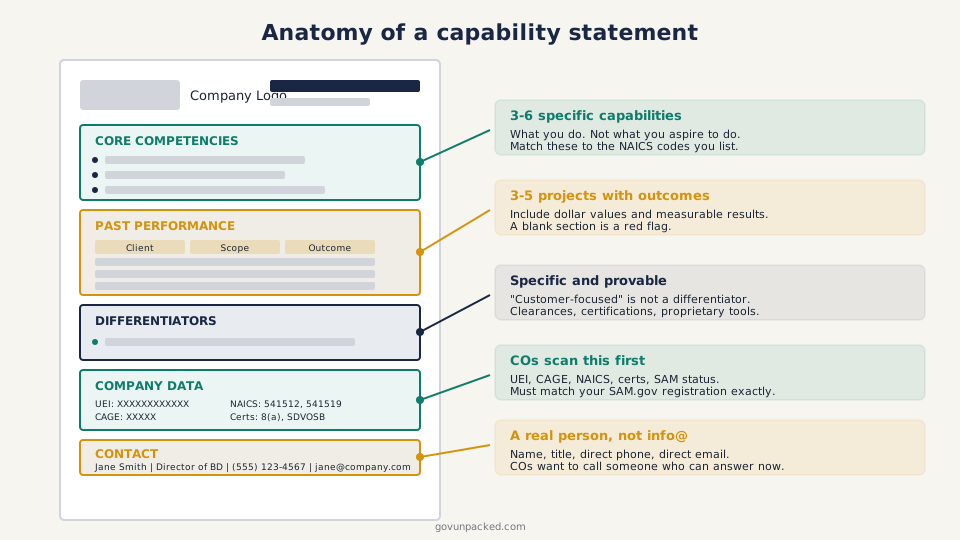
Every capability statement follows the same basic structure. Contracting officers expect it, and deviating from it just makes their job harder. Here are the five sections, in order of importance.
Core competencies
Three to six bullet points describing what your company actually does. Not what you aspire to do. Not a list of every service you’ve ever provided. The specific work you want the government to hire you for.
Bad example: “We provide comprehensive IT solutions, project management, consulting, training, logistics, and administrative support services.”
That tells a contracting officer nothing. You’ve listed six different industries in one sentence.
Good example:
- Network infrastructure design and deployment (DoD classified environments)
- Cybersecurity assessment and CMMC Level 2 compliance consulting
- Help desk and Tier II/III technical support (cleared personnel)
Three competencies. Specific. A contracting officer reading this knows exactly what contracts to match you to.
Past performance
Three to five projects where you did work similar to what you’re pitching. Each entry should include the client name (or “Federal Agency” if you can’t disclose), the contract value or scope, and a measurable outcome.
“Provided IT support to a federal agency” is useless. “Managed 24/7 help desk for U.S. Army CECOM, 15,000 users, 98.7% SLA compliance over 3 years” tells the reader everything they need.
If you don’t have federal past performance yet, use commercial contracts, state and local government work, or subcontracting experience. But list something. A blank past performance section is a red flag. It tells the reader you’ve never done the work you’re claiming to be capable of.
Differentiators
What makes you different from the 50 other small businesses with similar core competencies? This is not the place for “customer-focused” or “dedicated team of professionals.” Every company says that. None of it means anything.
Real differentiators look like this:
- “Only SDVOSB in the Mid-Atlantic region with active CMMC Level 2 certification”
- “Bilingual staff (English/Spanish) with existing clearances at DHS facilities”
- “Proprietary asset tracking system deployed across 14 VA medical centers”
If you can’t articulate a specific, provable differentiator, you have a business strategy problem that no template can fix.
Company data
This is the section contracting officers scan first. Put it in a clearly visible sidebar or header block. Include:
- UEI number (your 12-character Unique Entity Identifier)
- CAGE code (your 5-character DLA identifier)
- NAICS codes (list your primary 3-5 codes, not 15)
- Set-aside certifications (8(a), WOSB/EDWOSB, SDVOSB, HUBZone — whichever you hold)
- SAM.gov status (Active, with expiration date)
- Contract vehicles (GSA Schedule, BPAs, IDIQs you’re on)
- Bonding capacity (if applicable to your industry)
Plain English: why NAICS codes matter here
Contracting officers search for vendors by NAICS code. When they have a cybersecurity contract to award, they search for businesses under NAICS 541512 (Computer Systems Design Services) or 541519 (Other Computer Related Services). If your capability statement doesn’t list the right NAICS codes, they’ll never find you. But listing too many codes makes you look unfocused — stick to the 3-5 codes that match your core competencies.
Contact information
A specific person’s name, title, direct phone number, and email address. Not a generic info@ email. Not a 1-800 number. When a contracting officer wants to ask you a question, they want to call a human who can answer it right now.
Include your company name, physical address, and website URL here too.
The template
Here’s a one-page layout you can copy. The structure matters more than the design — a clean Word document or Google Doc works fine. You don’t need to hire a graphic designer, though a professional-looking document doesn’t hurt.
[Company Logo] | [Company Name]
[Tagline: one sentence describing what you do]
CORE COMPETENCIES
- [Competency 1: specific service or capability]
- [Competency 2: specific service or capability]
- [Competency 3: specific service or capability]
- [Competency 4: specific service or capability] (optional)
PAST PERFORMANCE
| Client | Scope | Outcome |
|---|---|---|
| [Agency/Company] | [What you did, contract value] | [Measurable result] |
| [Agency/Company] | [What you did, contract value] | [Measurable result] |
| [Agency/Company] | [What you did, contract value] | [Measurable result] |
DIFFERENTIATORS
- [Specific, provable advantage #1]
- [Specific, provable advantage #2]
COMPANY DATA (sidebar or footer)
| UEI | [12-character identifier] |
| CAGE Code | [5-character code] |
| NAICS | [Primary code], [Secondary], [Tertiary] |
| Certifications | [8(a) / WOSB / SDVOSB / HUBZone] |
| SAM.gov | Active (exp. [date]) |
| Contract Vehicles | [GSA Schedule #, BPAs, etc.] |
[Contact Name] | [Title] | [Phone] | [Email] | [Website]
Three examples that actually work
Example 1: IT services firm (8(a) certified)
Apex Federal Solutions, LLC Cybersecurity and IT infrastructure services for defense and civilian agencies
Core Competencies:
- Cybersecurity assessment, continuous monitoring, and incident response
- CMMC Level 2 compliance consulting and certification support
- Cloud migration planning and execution (AWS GovCloud, Azure Government)
Past Performance:
- U.S. Army CECOM: Managed enterprise cybersecurity operations, 22,000 endpoints, $4.2M task order, zero critical incidents over 24 months
- Department of Energy: Led cloud migration for 3 regional offices, $1.8M, completed 6 weeks ahead of schedule
- State of Virginia VITA: Penetration testing and vulnerability assessments, $600K annual contract, identified and remediated 340+ vulnerabilities
Differentiators:
- All technical staff hold active Secret or Top Secret clearances
- CMMC Registered Provider Organization with 2 certified assessors on staff
Company Data: UEI: J4K8M2N5P7R9 | CAGE: 3A7K2 | NAICS: 541512, 541519, 541611 | Certifications: SBA 8(a), SDB | SAM: Active (exp. 03/2027)
Example 2: construction firm (SDVOSB)
Ironclad Builders, Inc. General construction and facility maintenance for federal installations
Core Competencies:
- New construction and renovation of government facilities (LEED certified projects)
- HVAC, electrical, and plumbing maintenance and repair
- Environmental remediation and hazardous material abatement
Past Performance:
- U.S. Army Corps of Engineers (Fort Liberty): Barracks renovation, $6.1M, delivered on budget, LEED Silver certification achieved
- VA Medical Center (Durham): Emergency generator replacement across 3 buildings, $890K, completed during active hospital operations with zero patient disruptions
- GSA PBS Region 4: Tenant improvement buildout, $2.3M, 14,000 sq ft federal office space
Differentiators:
- $10M single-project bonding capacity
- Owner is combat veteran (OIF/OEF) with PE license in structural engineering
Company Data: UEI: R8T3W6Y2B5D1 | CAGE: 5K9M4 | NAICS: 236220, 238220, 562910 | Certifications: SDVOSB (VA VetCert) | SAM: Active (exp. 11/2026)
Example 3: professional services firm (WOSB)
Clearview Policy Group, LLC Program evaluation and data analytics for health and human services agencies
Core Competencies:
- Program evaluation design, implementation, and reporting
- Quantitative and qualitative data analysis (Stata, R, Tableau)
- Grant management and compliance monitoring
Past Performance:
- HHS/ACF: Evaluated 12 Head Start grantees across 5 states, $1.1M, findings adopted in FY2025 funding guidance
- CDC NCCDPHP: Built real-time data dashboard tracking chronic disease indicators, $750K, used by 200+ state and local health departments
- USAID (subcontract under Deloitte): Monitoring and evaluation framework for maternal health programs in 3 countries, $480K
Differentiators:
- Staff includes 4 PhDs in public health, epidemiology, and biostatistics
- Existing relationships with 35+ state health departments for data access agreements
Company Data: UEI: F2H5K8M1N4P7 | CAGE: 7B3D6 | NAICS: 541611, 541720, 541990 | Certifications: WOSB, EDWOSB | SAM: Active (exp. 07/2027)
Mistakes that get your capability statement thrown out
I’ve talked to contracting officers and APEX Accelerator counselors about what makes them stop reading. These are the most common problems.
Listing 10+ NAICS codes. If you claim you can do everything from IT to janitorial services to construction, you probably can’t do any of them well. Stick to 3-5 codes that align with your core competencies.
No past performance. A capability statement without past performance is like a resume with no work history. If you’re brand new, list commercial projects, subcontracting work, or relevant experience from before you incorporated. Just don’t leave it blank.
Generic differentiators. “Our team is dedicated to excellence and customer satisfaction.” That’s not a differentiator. That’s a sentence that could appear on literally any company’s website. Give them something specific and verifiable.
Wrong company name. Your capability statement must use the exact legal entity name that’s in SAM.gov. If your SAM registration says “Smith & Associates, LLC” and your capability statement says “Smith Associates” without the ampersand, a contracting officer may not be able to verify your registration. Small detail. Big problem.
More than one page. Contracting officers receive hundreds of these. If yours is two pages, page two probably isn’t getting read. If you can’t fit everything on one page, you’re including too much. Cut the company history paragraph. Cut the mission statement. Keep what matters.
Outdated SAM.gov status. If your SAM registration has expired, your capability statement is worthless. You can’t receive a contract award with an expired registration. Check your SAM renewal date before sending anything out.
When to use different versions
Don’t send the same capability statement to every audience. The structure stays the same, but the emphasis changes.
For a specific solicitation: Reorder your core competencies and past performance to match the requirements in the solicitation. If the RFP emphasizes cybersecurity and your capability statement leads with cloud migration, flip them. Mirror the agency’s language.
For a prime contractor: Emphasize your set-aside certifications prominently. Primes need subcontractors with specific certifications to meet their small business subcontracting plan goals. Lead with your WOSB, SDVOSB, or 8(a) status if you have it.
For industry days and matchmaking events: Use a general version that covers your strongest capabilities. Have printed copies ready. Contracting officers will flip through a stack of these after the event, so make yours scannable.
Where to get help (for free)
Your local APEX Accelerator (formerly called PTAC) will review your capability statement, help you write one from scratch, or help you tailor versions for specific agencies. The service is free. It’s funded through a Department of Defense cooperative agreement specifically to help small businesses win government contracts.
APEX counselors see hundreds of capability statements every year. They know what works in your region and for the agencies near you. If you haven’t visited your local office yet, this is a good reason to make an appointment.
The SBA also runs workshops on capability statement development through its district offices and Small Business Development Centers (SBDCs). These are also free.
Your next step
If you’ve already registered in SAM.gov and completed your first 30 days checklist, building your capability statement is the single most important thing you can do this week. Use the template above. Fill in real numbers, real projects, real differentiators. Then take it to your local APEX Accelerator for a review before you send it anywhere.