How to find expiring government contracts (incumbent research)
Every federal contract has an end date. When it expires, the agency either renews it (sole source, which is rare) or puts it back out for competition. That second scenario is called a recompete, and it’s the most predictable type of opportunity in government contracting. Roughly 85,000 contracts recompete every 18 months, representing over $180 billion in work that changes hands on a schedule you can track yourself for free.
The problem is timing. Most contractors find recompetes when the RFP hits SAM.gov. By that point, capture is functionally over. The incumbent has spent 12 months building relationships with the program office, shaping requirements, and assembling their team. You’re reading the solicitation for the first time. That’s not a competition — it’s a formality.
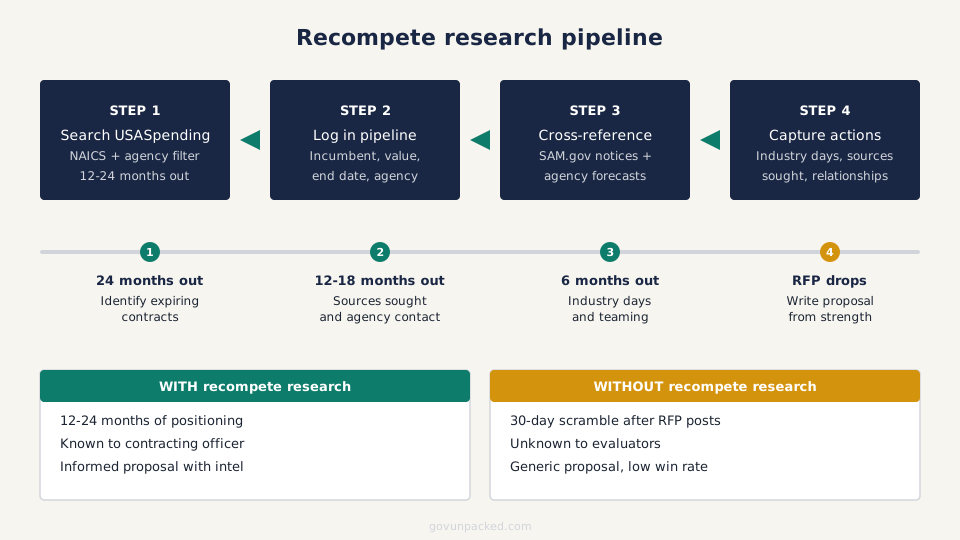
The fix is simple: find expiring contracts 12-24 months before the RFP drops. Here’s how.
USASpending.gov: your free intelligence tool
USASpending.gov tracks every federal contract dollar spent. It’s public, it’s free, and you don’t need an account. For recompete research, the contract awards search is where you’ll spend your time.
Here’s the process:
Step 1: Search by your NAICS code. Go to the Advanced Search page. Under Award Type, select “Contracts.” Under NAICS Code, enter the codes your business operates under. This immediately filters to contracts in your industry.
Step 2: Filter by agency. If you’re targeting specific agencies (and you should be), add an agency filter. Spreading yourself across 20 agencies is a waste of time. Pick 2-3 agencies where you have past performance or where your services are a natural fit.
Step 3: Look at period of performance dates. Each contract award shows a start date and a current end date (including exercised options). A 5-year contract awarded in 2021 with all options exercised ends in 2026. That contract will be recompeted — and the agency is probably already doing market research for it right now.
Step 4: Identify the incumbent. USASpending tells you exactly who holds the contract, the total value, the awarding agency, and where the work is performed. Write this down. The incumbent is your competitor, and everything you learn about their contract helps you position against them.
Plain English translation
USASpending.gov is a public database of every federal contract. You can search it by industry code and agency to find contracts that are about to expire. When a contract expires, the government usually has to rebid it. If you find those contracts 12-24 months early, you can start positioning before the solicitation is even written.
What to do with what you find
Finding an expiring contract is step one. The next moves matter more.
Cross-reference with SAM.gov. Once you know a contract is expiring, search SAM.gov for pre-solicitation notices, sources sought notices, or RFIs related to that requirement. Agencies often post these 6-12 months before the full RFP. If you see a sources sought notice for a requirement you’ve already researched, you’re ahead of 90% of respondents.
Check agency procurement forecasts. Many federal agencies publish annual procurement forecasts listing planned acquisitions for the coming fiscal year. These forecasts often include recompetes and tell you the estimated value, expected release quarter, competition type, and a point of contact. Search for “[Agency Name] procurement forecast” or check the agency’s Office of Small and Disadvantaged Business Utilization (OSDBU) page. Not every agency publishes one, but when they do, it’s a goldmine.
Research the incumbent’s performance. FPDS (now part of SAM.gov’s contract data) shows modification history, funding amounts, and whether options were exercised. If the government didn’t exercise all option years, that signals dissatisfaction. An unhappy agency is more likely to switch contractors. That’s your opening.
Start relationship-building. Email the contracting officer or the small business specialist at the agency. Attend industry days. If the agency runs a pre-solicitation conference for the recompete, be there. The goal isn’t to sell — it’s to make your company known to the people who will evaluate proposals. When your name shows up on a proposal 6 months later, they should recognize it.
Build a recompete pipeline
Don’t do this research once and forget about it. Set up a quarterly discipline:
- Search USASpending for contracts in your NAICS codes expiring in the next 12-24 months.
- Log each one in a spreadsheet: contract number, agency, incumbent, value, end date, and status of any pre-solicitation activity on SAM.gov.
- For your top 5-10 targets, assign capture actions: attend industry events, respond to sources sought notices, request meetings with the program office.
- Update monthly. Contracts get extended, options get exercised, timelines shift.
This is capture management at its simplest. You don’t need expensive software. You need a spreadsheet, USASpending, and the discipline to check it regularly.
What about paid tools?
Services like GovWin, Bloomberg Government, and Deltek offer contract intelligence with expiring-contract alerts and incumbent analysis. They’re useful if you can afford them ($3,000-$15,000/year depending on the platform). But they’re pulling from the same public data sources described here — USASpending, FPDS, SAM.gov. The value they add is convenience, not access. If you’re a small business with a tight pipeline, do the research yourself first. Upgrade to paid tools when your pipeline is large enough to justify the cost.
The math that makes this worth your time
Here’s what happens without recompete research: you check SAM.gov, see an RFP posted two days ago with a 30-day response window, and scramble to write a proposal against an incumbent who has been positioning for a year. Your win probability is in single digits.
With recompete research: you identified the opportunity 14 months ago. You responded to the sources sought notice. You attended the industry day. You met the small business specialist. You’ve read the incumbent’s contract and know what the government is paying. When the RFP drops, you’re writing a proposal informed by a year of intelligence. Your win probability isn’t guaranteed, but it’s a real number.
The contractors who consistently win federal work aren’t smarter than you. They started looking earlier. USASpending.gov is free, it’s public, and it’s the same data the big firms use. The only difference is whether you use it.
Your next step: pick your top two NAICS codes and your top two target agencies. Run the search on USASpending.gov today. If you’re still figuring out which agencies to target, start with the how to read a government solicitation guide to understand what you’re looking at when you find one.