How to read a government solicitation: RFP sections A through M explained
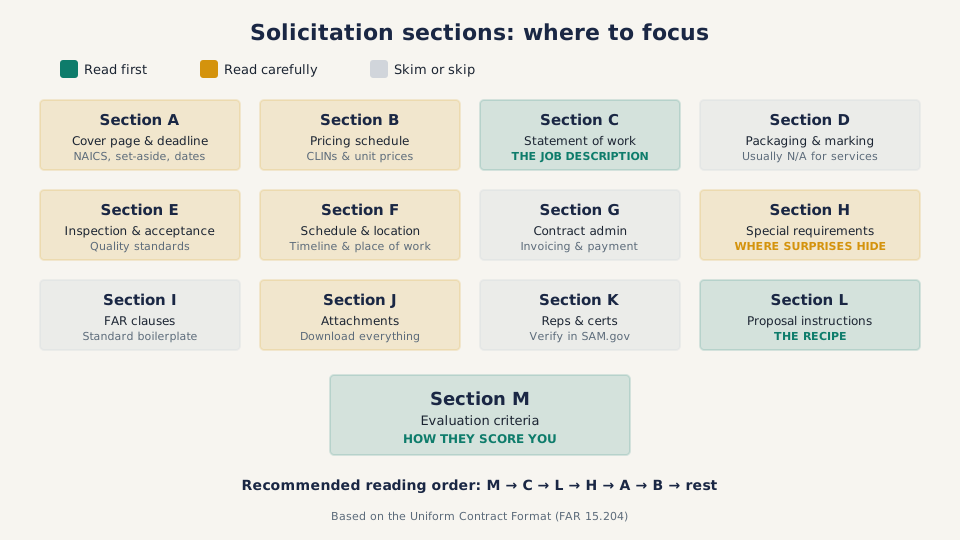
A federal solicitation follows a standardized structure called the Uniform Contract Format (UCF), defined in FAR 15.204. It has 13 sections labeled A through M. Most of the document is boilerplate contract language you don’t need to read word-for-word. The sections that determine whether you win or lose are Section C (the work itself), Section L (how to format your proposal), and Section M (how they’ll score it). Read those three first, then work backward through the rest.
If you’ve pulled up your first solicitation on SAM.gov and felt your stomach drop at 150 pages of dense regulatory text, you’re not alone. That reaction is the single biggest barrier to entry in government contracting. The document looks impenetrable, but it follows a predictable pattern once you know the map.
Before the solicitation: know what you’re looking at
Not every opportunity on SAM.gov is an actual solicitation asking for proposals. The government posts several types of notices, and confusing them wastes time.
Request for Proposal (RFP). The government knows what it wants but needs vendors to propose their approach, qualifications, and price. Award goes to the “best value” offer — not necessarily the cheapest. This is the most common solicitation type for services and complex procurements, and it’s what the UCF sections below describe.
Request for Quotation (RFQ). Used for commercial items and simpler purchases, often under the simplified acquisition threshold ($250,000). Less formal than an RFP. You’re quoting a price for a defined deliverable, not writing a full proposal.
Invitation for Bids (IFB). Sealed bidding. The government has exact specifications, and the lowest responsive, responsible bidder wins. Common for construction and commodity purchases. No negotiations, no technical evaluation — just price.
Sources Sought / Request for Information (RFI). Not a solicitation at all. The agency is doing market research to see if capable vendors exist before deciding to issue a real solicitation. Always respond to these if you’re qualified — your response can influence whether the contract gets set aside for small business and how the requirements get written.
For a full glossary of these terms, see the government contracting acronym glossary.
The Uniform Contract Format: sections A through M
Here’s what each section contains, what matters to you as a bidder, and what you can safely skim.
Section A: solicitation/contract form
The cover page. It’s a Standard Form (SF) 33, SF 1449, or SF 18, depending on the procurement type. This tells you:
- Solicitation number (you’ll reference this on every piece of correspondence)
- Issue date and response deadline
- Contracting officer name and contact info
- Whether it’s a set-aside (small business, 8(a), WOSB, SDVOSB, HUBZone)
- NAICS code and size standard
What to do: Read it. Write down the deadline, the contracting officer’s name, the NAICS code, and the set-aside status. If the NAICS code doesn’t match your business, stop here. If you’re not sure whether your business qualifies under the size standard, check the set-aside certifications guide.
Section B: supplies or services and prices/costs
The pricing schedule. This section tells you what the government is buying in terms of contract line item numbers (CLINs). Each CLIN represents a deliverable or service category with a quantity and unit of measure.
You’ll fill in your proposed prices here. For fixed-price contracts, that means a firm price per CLIN. For cost-reimbursement contracts, you’ll estimate costs and apply fees.
What to do: Study the CLIN structure carefully. It tells you exactly how the government will pay you, and it reveals how they think about the work. If CLINs are broken into base year plus option years, expect a multi-year contract. If there’s a “travel” CLIN, budget for it. Missing a CLIN in your pricing is grounds for disqualification.
Section C: description/specifications/statement of work
This is the most important section in the entire document. Section C describes the actual work. It may be called a Statement of Work (SOW), Performance Work Statement (PWS), or Statement of Objectives (SOO), depending on whether the government is prescribing how to do the work or just what outcomes they want.
What to do: Read every word. Then read it again. Highlight requirements that use the word “shall” — in government contracts, “shall” means mandatory. “Should” means desirable but not required. “May” means optional. This distinction matters. If Section C says “the contractor shall provide weekly status reports,” that’s a hard requirement you must address in your proposal. If it says “the contractor should have experience with Agile methodologies,” that’s a preference, not a pass/fail gate.
Plain English translation
Section C = the job description. It tells you what the government wants done, to what standards, and where. Everything in your technical proposal (Section L) should map directly back to requirements in Section C. If Section C doesn’t mention it, don’t propose it. If Section C does mention it, you’d better address it.
Section D: packaging and marking
How to package and label deliverables for shipment. Relevant for product contracts. For services, this section is usually short or says “Not applicable.”
What to do: Skim it. If you’re providing physical goods, read the packaging specs. Otherwise, move on.
Section E: inspection and acceptance
How the government will inspect your work and decide whether to accept it. Defines the quality standards, who has authority to accept deliverables, and what happens if your work doesn’t pass inspection.
What to do: Read for the acceptance criteria. This tells you what “done” looks like to the government. If the section references specific quality standards (ISO, AS9100, CMMI), make sure you can meet them before you bid.
Section F: deliveries or performance
The schedule. When does work start? When are deliverables due? Where does the work happen? This section defines the period of performance, delivery schedules, and the place of performance.
What to do: Check that the timeline is realistic for your company. If the period of performance is 12 months but the work clearly requires 18, that’s a red flag — either the government underestimates the scope, or they expect a team larger than what a small business can field. Also check the place of performance. If it requires on-site work at a government facility, factor in security clearance timelines and travel costs.
Section G: contract administration data
Identifies who administers the contract on the government side — the Contracting Officer’s Representative (COR), invoicing instructions, payment office, and reporting requirements. This is the operational “who do I talk to and how do I get paid” section.
What to do: Note the invoicing method (usually the Wide Area Workflow system, now called the Invoice Processing Platform). If you’ve never invoiced the government before, this is not the time to learn it for the first time on a live contract. Your local APEX Accelerator can walk you through the system before you need it.
Section H: special contract requirements
Catch-all for requirements that don’t fit elsewhere. This is where agencies add clauses specific to this contract — security clearance requirements, key personnel designations, organizational conflict of interest provisions, insurance minimums, or small business subcontracting plan requirements.
What to do: Read every clause. Section H is where surprises live. A key personnel clause means the government wants specific people assigned to the contract, and replacing them requires government approval. A security clearance requirement means your staff need active clearances before work starts — you can’t just apply after winning. An organizational conflict of interest clause might disqualify you if you’ve done related work for a competitor.
Section I: contract clauses
The Federal Acquisition Regulation (FAR) clauses incorporated by reference. This section typically lists 30-60 FAR clause numbers with titles. Most are standard boilerplate that applies to all government contracts of this type.
What to do: You don’t need to read every FAR clause before bidding, but you should scan for a few key ones:
- FAR 52.219-14 (Limitations on Subcontracting): If this is a small business set-aside, you must perform a certain percentage of the work yourself. You can’t just pass it all to a large business sub.
- FAR 52.222-46 (Evaluation of Compensation for Professional Employees): The government will evaluate whether your proposed labor rates are realistic. Lowballing salaries to win on price will backfire.
- FAR 52.215-1 (Instructions to Offerors): Sometimes referenced here instead of Section L.
Section J: list of attachments
An index of documents attached to the solicitation — past performance questionnaires, technical reference documents, data item descriptions, maps, building plans, or government-furnished property lists.
What to do: Download and review every attachment. Section J attachments often contain critical details that aren’t repeated in the main solicitation. A floor plan tells you the actual workspace. A data item description (DID) specifies the exact format the government wants for your deliverable. Missing an attachment means missing context.
Section K: representations and certifications
Standardized forms where you certify your business status — small business size, ownership, tax compliance, debarment status, and other legal representations. Most of these are maintained in your SAM.gov registration, and the solicitation will say “complete online at SAM.gov” rather than requiring paper forms.
What to do: Make sure your SAM.gov representations and certifications are current. If they expired or were never completed, fix that before the proposal deadline. The SAM registration guide covers the full process.
Section L: instructions to offerors
How to write and submit your proposal. Section L tells you:
- Page limits (violating page limits can get you eliminated without evaluation)
- Font size and margin requirements
- What volumes to submit (typically Volume I: Technical, Volume II: Past Performance, Volume III: Price)
- What each volume should contain and how it should be organized
- Submission method (email, SAM.gov portal, or physical delivery)
- Questions deadline and amendment procedures
What to do: Treat Section L like a recipe. Follow it exactly. If it says 50 pages, don’t submit 51. If it says 12-point Times New Roman with 1-inch margins, don’t use 11-point Arial. If it says organize your technical approach around five subfactors, use those five subfactors as your headings. Evaluators review dozens of proposals. They don’t have time to hunt for your qualifications — put the information exactly where they told you to put it.
Section M: evaluation factors for award
How the government will score your proposal. This is the second most important section after Section C. Section M tells you what matters to the evaluators and how much it matters.
Common evaluation structures:
- Best value tradeoff: Technical and past performance are more important than price (or vice versa). The solicitation will state the relative importance — “technical is significantly more important than price” or “all factors are approximately equal.”
- Lowest price technically acceptable (LPTA): If your proposal meets the technical requirements, the lowest price wins. No tradeoff. Pure price competition after clearing a technical bar.
- Highest technically rated with a fair and reasonable price: The government picks the best technical proposal and just checks that the price isn’t unreasonable.
What to do: Let Section M drive your proposal strategy. If technical approach is worth 60% and price is worth 40%, invest your effort accordingly. If past performance is “most important,” make sure your past performance volume is bulletproof. If it’s LPTA, don’t gold-plate your technical proposal — meet the requirements, keep it clean, and compete on price.
Tip
Read Section M first, then Section C, then Section L. Section M tells you what the government values. Section C tells you what they need. Section L tells you how to package your answer. Working in this order means you’ll read the statement of work with evaluation criteria already in mind, and you’ll spot the connections between requirements and scoring that shape a winning proposal.
The five-minute triage: deciding whether to bid
You don’t have time to write a full proposal for every solicitation that crosses your desk. Before investing hours into a response, run through this checklist:
- NAICS code and size standard. Does your business qualify? If the size standard is $16.5 million in average annual receipts and you’re at $18 million, you’re out.
- Set-aside status. If it’s set aside for 8(a) and you’re not in the 8(a) program, move on. If it’s full and open, expect larger competitors.
- Place of performance. Can you actually deliver where they need it? Don’t bid on a contract requiring on-site staff in Honolulu if your team is in Ohio and nobody’s willing to relocate.
- Period of performance. Does the timeline work? If it starts in 30 days and you’d need 90 days to hire staff, that’s a problem.
- Section M evaluation factors. If past performance is the most important factor and you have zero government contract experience, your odds are low. Consider teaming with an experienced prime or pursuing a subcontracting role first.
What changed in 2025: the FAR overhaul
If you’re reading solicitations issued after November 2025, you may notice some new language. Executive Order 14275 kicked off a “Revolutionary FAR Overhaul” (RFO) that includes a class deviation to FAR Part 15 — the part that governs how competitive solicitations work.
The practical changes for bidders:
- “Discussions” are now called “negotiations.” Same process, different word. If the contracting officer enters negotiations with you after your initial proposal, that’s your chance to strengthen weaknesses.
- Competitive range flexibility. The government now has more discretion in how many offerors make the competitive range. Previously, it included “all of the most highly rated proposals.” Now it’s “proposals best suited for further negotiation.”
- Unequal negotiations are allowed. The government can negotiate with one offeror without being required to negotiate with all. If you’re in the competitive range, being responsive and flexible matters more than ever.
The FY 2026 National Defense Authorization Act also raised the certified cost or pricing data threshold from $2.5 million to $10 million for defense contracts, effective July 2026. If you’re bidding on DoD contracts under $10 million, you’ll face less pricing paperwork than before.
Common mistakes that kill first-time proposals
Not answering the mail. The solicitation asks for X, and your proposal talks about Y. Every requirement in Section C needs a corresponding response. Every evaluation factor in Section M needs to be addressed. Evaluators use a checklist. If your proposal doesn’t hit every item, you get a weakness or deficiency.
Ignoring page limits. Evaluators can stop reading at the page limit. Some will. Everything after page 50 (or whatever the limit is) might as well not exist.
Pricing without understanding the CLINs. Leaving a CLIN unpriced, or pricing it at $0, can make your proposal nonresponsive. If a CLIN exists, the government expects a price for it.
Submitting late. The deadline in Section A is absolute. There’s no grace period, no “but my email server was slow.” SAM.gov submission portals can be unreliable near deadlines. Submit at least 24 hours early.
Skipping Section H. The special requirements in Section H can contain dealbreakers — security clearance mandates, insurance minimums, key personnel requirements. If you can’t meet them, you can’t perform the contract. Better to know that before you spend three weeks writing a proposal.
Your next move
Pull up one active solicitation on SAM.gov in your NAICS code. Don’t try to bid on it yet. Just read it using the section-by-section breakdown above. Start with Section M, then Section C, then Section L. Time yourself — after the first one, the format will feel familiar, and each subsequent solicitation will take half as long to digest.
If you want a structured approach to your first proposal, a capability statement is the prerequisite. And if you’re not registered in SAM.gov yet, that’s step zero — the registration guide covers the full process.
The solicitation format is designed to be thorough, not to scare you off. Once you see the pattern, 150 pages turns into 15 pages that actually matter and 135 pages of standard contract language that rarely changes. The agencies that wrote these solicitations want qualified small businesses to respond. They just wrote the requirements in government, and now you speak it too.