Subcontracting vs prime contracting: which is right for your business?
Most small businesses should start as subcontractors. If you lack federal past performance, can’t secure surety bonds, or don’t have a proposal-writing team, subcontracting gets you into the federal marketplace with a fraction of the overhead. Once you’ve built a track record and learned the system from the inside, you shift to prime contracts where the revenue and control are better.
That’s the short answer. But the right path depends on where your business is today, and the difference between the two roles is bigger than most people realize.
What “prime” and “sub” actually mean
A prime contractor holds the contract directly with the federal government. You bid on a solicitation, the contracting officer picks your proposal, and you sign the contract. You’re responsible for everything — the work, the compliance, the reporting, the subcontractor management. If something goes wrong, it’s your problem.
A subcontractor works under the prime. You have no direct relationship with the government. Your contract is with the prime contractor, not the agency. The prime found you, brought you onto the team, and manages the government relationship. You deliver your piece of the work and the prime pays you.
Plain English: privity of contract
“Privity” just means you’re a legal party to the contract. As a prime, you have privity with the government — you can negotiate directly, file claims, and talk to the contracting officer. As a sub, you have privity with the prime only. If the government owes money or changes the scope, everything goes through the prime. You can’t call the contracting officer yourself.
That single distinction — who your contract is with — drives every other difference.
The requirements gap
Here’s where the two paths diverge sharply.
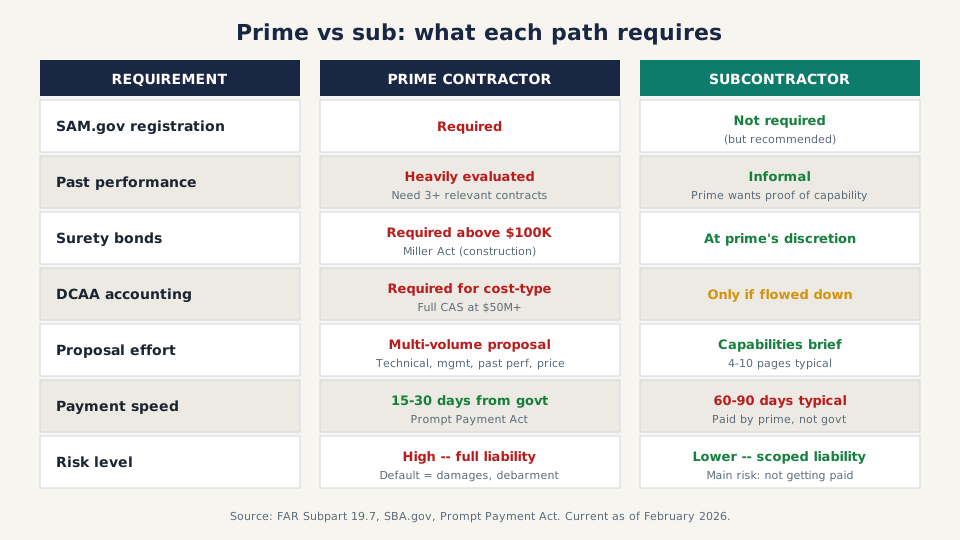
| Requirement | Prime contractor | Subcontractor |
|---|---|---|
| SAM.gov registration | Mandatory | Not required (but recommended) |
| Past performance | Heavily weighted in evaluations | Informal — prime just wants proof you can deliver |
| Surety bonds (construction) | Required above $100K (Miller Act) | At prime’s discretion |
| DCAA-compliant accounting | Required for cost-type contracts | Only if prime flows it down |
| Proposal effort | Multi-volume technical, management, past performance, price | Capabilities brief or quote |
| Security clearances | If contract requires it | If your scope requires it |
| CMMC (DoD) | Required for CUI/FCI handling | Same — applies at every tier |
The proposal effort alone is worth understanding. When I bid my first prime contract, the proposal took three people six weeks. Technical volume, management approach, past performance references, pricing worksheets, reps and certs. When I submitted my first subcontractor capabilities package, it was a four-page PDF and a phone call.
Revenue and payment: the trade-off
Prime contractors earn more per contract because they control the full scope. In FY2024, the federal government awarded $183 billion in prime contracts to small businesses. The average small business prime award was $2.7 million.
Subcontractors earn on their portion only. But the federal subcontracting market isn’t small — roughly $72 billion flows to small business subs annually. For businesses without the infrastructure to manage a full prime contract, that $72 billion is accessible revenue that would otherwise be $0.
The real difference is how fast you get paid.
Primes get paid by the government under the Prompt Payment Act — typically within 15-30 days of a proper invoice. The government pays interest penalties if it’s late. Subcontractors get paid by the prime. In theory, primes must pay subs within 7 days of receiving government payment (for construction). In practice, 60-90 days is common. More than 80% of contractors report dealing with slow payments from primes.
Watch the payment terms
Before signing any subcontract, look for “pay-when-paid” or “pay-if-paid” clauses. “Pay-when-paid” means the prime pays you after they get paid. “Pay-if-paid” means the prime only pays you if the government pays them. One is a timing issue. The other transfers the government’s credit risk to you. Know which one you’re signing.
Risk: one side carries the weight
As a prime, you’re on the hook for everything. If your subcontractor delivers late or delivers garbage, the government holds you responsible. Termination for default can mean repaying money already earned, paying liquidated damages, covering the cost of the government re-procuring the work, and getting a negative past performance rating that follows you for years.
As a sub, your risk is narrower. You’re responsible for your piece of the work, and your contract is with the prime — not the government. Your biggest risk isn’t performance failure; it’s getting stiffed. If the prime runs into cash flow problems or goes under, your recourse is limited. You can’t claim against the government directly because you have no privity with them.
When to sub, when to go prime
Subcontracting is the right starting point if any of these describe your business:
- No federal past performance. Without documented contract performance, you’ll lose on past performance evaluations every time. Subbing builds that track record.
- No proposal capability. Federal proposals are technical documents that follow rigid structures. If you haven’t written one, learning on a $2 million bid isn’t the time to practice.
- No bonding capacity. Construction contracts above $100K require surety bonds. If you can’t get bonded, you can’t prime construction work. Period.
- Limited cash reserves. Government payment cycles mean funding 30-90 days of operations out of pocket. If that would break you, sub first.
Go straight to prime if you can check these boxes:
- You have relevant past performance (even commercial work that directly applies).
- A set-aside contract matches your certification — 8(a), SDVOSB, WOSB, or HUBZone set-asides have less competition by design.
- The contract is under the $250K simplified acquisition threshold, where procedures are streamlined.
- You have 60-90 days of operating cash to bridge government payment cycles.
Most govcon advisors recommend a hybrid approach: sub for your first year or two to build past performance and learn the procurement system, then start bidding small set-aside prime contracts ($25K-$250K) while keeping your sub work going. That’s not a “play it safe” strategy. It’s the strategy that actually works. You build your prime portfolio gradually instead of betting the company on a single proposal.
The certification multiplier
Here’s something that changes the math on both sides. If your business qualifies for set-aside certifications — 8(a), SDVOSB, WOSB, or HUBZone — you become more valuable in both roles.
As a sub, primes actively seek you out. Every large prime with a contract over $750K must meet subcontracting goals for each small business category. A firm that’s both SDVOSB and SDB counts toward two goals at once. Primes love that. You go from cold-calling to being recruited.
As a prime, certifications unlock sole-source contracts up to $4.5 million ($7 million for manufacturing) and set-aside competitions where only certified firms can bid. The SDVOSB goal was raised from 3% to 5% in the FY2024 NDAA, which means agencies are actively looking for more veteran-owned firms to hit their targets.
If you haven’t looked into which certifications you qualify for, start there. The certification guide breaks down eligibility, contract volume, and which programs are actually worth the paperwork.
Your next move
If you’re new to government contracting and trying to figure out which path to take, start with your first 30 days checklist. Get registered in SAM.gov, build your capability statement, and start identifying primes in your industry who need subs.
If you’re ready to start subcontracting, read becoming a government subcontractor for the step-by-step process, then move to how to find government subcontracting work for the tools and databases that connect you with primes.
The question isn’t whether to sub or prime. For most small businesses, it’s whether to sub first or sub only. Start as a sub, build your record, and make the jump to prime when you’ve got the infrastructure to back it up.