Do I need a GSA Schedule? (Pros, cons, and myths)
No, you don’t need a GSA Schedule to sell to the federal government. Agencies buy from the open market every day, especially for contracts under the simplified acquisition threshold. But a GSA Schedule makes you dramatically easier for contracting officers to buy from — and in government procurement, easy wins.
That’s the short answer. The longer answer depends on what you sell, who you sell it to, and whether your business can absorb the 3-6 month application process before seeing a single dollar in return.
What a GSA Schedule actually is
A GSA Schedule (officially called the Multiple Award Schedule, or MAS) is a long-term government-wide contract between your company and the General Services Administration. You negotiate your pricing upfront, agree to GSA’s terms and conditions, and in return, every federal agency — plus many state and local governments — can buy from you using a streamlined ordering process.
Think of it like getting approved as a vendor in a massive procurement catalog. Once you’re in, government buyers can place orders directly from your contract without running a full competitive solicitation. That’s a big deal. A typical open-market procurement can take 3-6 months. An order off a GSA Schedule can happen in days.
Plain English: A GSA Schedule is pre-approved pricing for the entire federal government. Instead of competing for each individual contract from scratch, agencies can order from your Schedule the way you’d order from an approved vendor list at work.
Your Schedule contract lasts five years with three five-year option periods — up to 20 years total if you keep the contract active and in compliance.
The real pros
Government buyers prefer you
Here’s the thing nobody tells you upfront: many contracting officers default to GSA Schedules because it’s the path of least paperwork for them. FAR 8.4 actually directs agencies to consider Schedule contracts before going to the open market for many purchases. You’re not just on a list — you’re on the preferred list.
In FY2025, GSA Schedule sales hit $57.7 billion. That’s real money flowing through one contract vehicle. About 35% of that — roughly $18-20 billion — went to small businesses.
Less competition than you’d think
Only about 4% of small businesses registered in SAM.gov hold a GSA Schedule. When a contracting officer issues a Request for Quote to Schedule holders in your category, you’re competing against a much smaller pool than the open market. And 44% of government awards receive only one bid. Read that again. Nearly half the time, the only company that shows up wins.
Your pricing is pre-negotiated
Once your Schedule is in place, you’ve already cleared the pricing hurdle. Contracting officers don’t need to negotiate from scratch or justify your rates through a separate price analysis. Your prices are already deemed fair and reasonable by GSA. That removes a major friction point in the buying process.
You show up where buyers are shopping
GSA Advantage is the government’s online shopping portal. Schedule holders are listed there automatically. Contracting officers search it the way you’d search Amazon — by keyword, category, or specific product. If you’re not on GSA Advantage, you’re invisible to the buyers who shop there. And a lot of them shop there.
The real cons
The application is a beast
The GSA Schedule application isn’t a form you fill out over lunch. It’s essentially a full proposal — you’re responding to GSA’s open solicitation with your commercial pricing, sales history, technical capabilities, and compliance documentation.
Expect 3-6 months from submission to award, and that’s after you’ve assembled the package. IT services sometimes move faster (3-4 months). Other categories — furniture, for example — can stretch past a year.
You’ll need:
- At least two years of commercial sales history in whatever you’re proposing
- A digital certificate (~$250/year) for the eOffer system
- Commercial price lists with GSA-negotiated discounts
- Detailed technical proposals for each Special Item Number (SIN) you’re pursuing
- Past performance documentation
Many companies hire consultants to help, which runs $5,000-$25,000 depending on complexity. That’s real money for a small business with no guarantee of return.
No sales are guaranteed
This is the myth that burns the most people. Getting a GSA Schedule does not mean orders start rolling in. The Schedule is a license to compete, not a guaranteed revenue stream. You still have to market to agencies, respond to RFQs, build relationships with contracting officers, and actually deliver.
I’ve seen companies spend months getting their Schedule awarded, then sit there wondering why the phone isn’t ringing. The Schedule gets you in the catalog. You still have to convince buyers to pick you.
Compliance isn’t optional
Once you hold a Schedule, you have ongoing obligations:
- Monthly sales reporting through GSA’s Sales Reporting Portal (due within 30 days after each month-end)
- Quarterly Industrial Funding Fee (IFF) payments — currently 0.75% of all Schedule sales, due within 30 days after each quarter
- Price reduction clauses that may require you to lower your GSA prices if you lower your commercial prices
- Annual contract modifications as your offerings, pricing, or company details change
Miss your sales reports or IFF payments and GSA can terminate your contract for cause. Even if you have zero sales, you still need to file those reports. Every month.
It locks in your pricing
Your GSA pricing becomes a ceiling. You can always offer lower prices on individual orders, but you can’t charge more than your Schedule rate. If you underprice your initial proposal trying to look competitive, you’re stuck with those rates until you negotiate a modification. And GSA doesn’t make modifications easy.
The five myths
Myth 1: “You need a GSA Schedule to sell to the government”
False. Agencies buy from the open market constantly, especially through simplified acquisition procedures for purchases under $350,000. Set-aside contracts for small businesses are frequently competed on the open market. You can win federal work without a Schedule.
Myth 2: “A GSA Schedule guarantees sales”
Already covered this one, but it’s worth repeating: no, it doesn’t. A Schedule is a vehicle, not a destination. Companies with Schedules that don’t actively market to agencies often see zero sales.
Myth 3: “Only big companies get GSA Schedules”
Not true. The majority of Schedule holders are small businesses. GSA actively encourages small business participation, and the application process doesn’t favor large companies — it favors companies with solid commercial track records and the patience to complete the paperwork.
Myth 4: “The application fee is expensive”
There is no application fee. Zero. The costs are indirect: the digital certificate, your time assembling the proposal, and optionally a consultant. But GSA itself doesn’t charge you to apply or to hold a Schedule.
Myth 5: “Once you get it, you’re set for 20 years”
Your Schedule can last up to 20 years, but only if you actively maintain it. That means filing sales reports, paying IFF fees, keeping your pricing current, and responding to GSA’s periodic requests for information. Neglect it and your Schedule gets canceled.
When a GSA Schedule makes sense
A Schedule is worth pursuing if:
- You sell products or services that agencies buy repeatedly. IT services, office supplies, consulting, janitorial services, cybersecurity — anything where agencies need ongoing procurement access.
- You have at least two years of commercial sales. GSA requires this. No exceptions.
- Your target agencies actively use GSA Schedules. Some agencies lean heavily on Schedules for most purchases. Others prefer open-market competition or agency-specific contract vehicles.
- You can absorb the time investment. If your business depends on winning a contract this quarter to keep the lights on, the 3-6 month Schedule timeline doesn’t help you.
- You’re ready for compliance overhead. Monthly reporting, quarterly fees, pricing management — this is real administrative work.
When to skip it (or wait)
Hold off on the GSA Schedule if:
- You’re brand new to GovCon. Get your SAM.gov registration done, build your capability statement, and win a few open-market contracts first. The commercial sales history you build will strengthen your eventual Schedule application.
- You’re focused on subcontracting. If your strategy is subcontracting to primes, you don’t need your own Schedule. The prime’s contract vehicle covers the transaction.
- Your product is highly customized or project-based. Schedules work best for commodity-ish offerings with repeatable pricing. One-off engineering projects or custom software builds may not fit cleanly into a Schedule SIN.
- You can’t commit to the compliance burden. If you don’t have someone who can file monthly sales reports and manage quarterly IFF payments, a Schedule will become a liability instead of an asset.
The alternative path that most people overlook
Here’s what the GSA consultants won’t tell you: you can build a successful government contracting business entirely on open-market contracts. Simplified acquisition contracts under $350,000 are set aside for small businesses in many cases. Agencies post these on SAM.gov. You compete, you win, you build past performance.
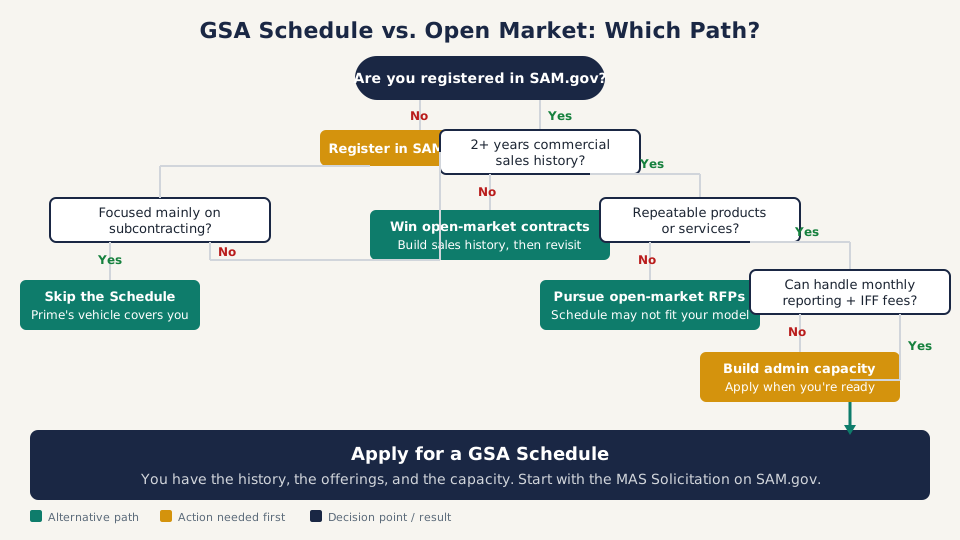
That past performance then makes your eventual GSA Schedule application stronger. And in the meantime, you’re generating revenue and learning how the government buys — without the compliance overhead of maintaining a Schedule with zero sales on it.
Another option: you can sell through an existing GSA Schedule holder as a reseller or subcontractor. You lose some margin, but you gain access to the Schedule channel without the application process.
The bottom line
A GSA Schedule is one of the most powerful tools in government contracting — but it’s a tool, not a magic wand. It makes you easier to buy from, puts you in front of buyers who prefer Schedule purchases, and gives you a competitive edge in a smaller bidding pool.
But it’s not free. It costs time, attention, and ongoing compliance effort. If you’re a small business just getting started in GovCon, your first priority should be winning work — any work — through open-market opportunities and simplified acquisition contracts. Build that track record. Then pursue the Schedule from a position of strength.
Your next step: if you’ve been in business for two years and have consistent commercial sales, pull up the GSA MAS Solicitation and read the requirements for your category. That’s the only way to know whether the fit is right for your specific business. And if you’re not there yet, focus on the first 30 days checklist instead.