Becoming a government subcontractor: lower barrier than prime
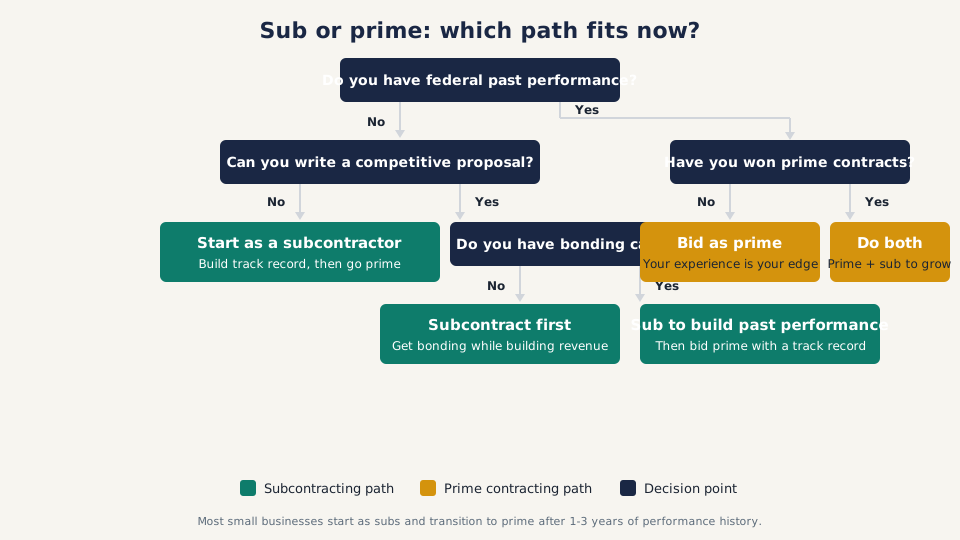
You don’t need past performance, surety bonds, or a 200-page proposal to start earning federal contract dollars. Government subcontracting lets small businesses do real work on federal contracts by partnering with an established prime contractor who already won the bid. The prime manages the government relationship. You deliver the work and get paid.
When I first looked at government contracting, I spent weeks reading about SAM.gov registration, proposal writing, and evaluation criteria. What nobody mentioned until I was deep into a PTAC counseling session was that subcontracting existed as a separate path entirely. The counselor said something that stuck with me: “Most small businesses that succeed as primes started as subs.” She was right. Subcontracting is the apprenticeship model of federal procurement, and the barrier to entry is dramatically lower.
Why subcontracting exists (and why primes need you)
The federal government doesn’t just encourage subcontracting. It requires it.
Under FAR 19.702, any prime contractor that isn’t a small business must submit a subcontracting plan on contracts over $750,000 ($1.5 million for construction). That threshold is rising to $900,000 ($2 million for construction) on October 1, 2025, but the obligation isn’t going anywhere. Large primes are legally required to set goals for how much work they’ll send to small businesses.
Plain English: subcontracting plan
When a large company wins a government contract worth more than $750,000, the law says they have to plan how much of that work they’ll farm out to small businesses. They set specific dollar targets for small businesses, women-owned businesses, veteran-owned businesses, and other categories. If they don’t hit those targets, they’re in material breach of their contract. That’s not a suggestion. That’s a legal requirement with real consequences.
This isn’t optional window dressing. A prime contractor that fails to make a good-faith effort to meet their subcontracting goals faces liquidated damages. The SBA tracks compliance through the Electronic Subcontracting Reporting System (eSRS), and primes must file reports twice a year showing how much they actually spent with small business subs.
In FY2023, small business subcontractors received $86.4 billion in federal subcontracting dollars. That’s 33.34% of all subcontract spending, which beat the government-wide goal by more than 2 percentage points. That $86.4 billion isn’t charity. It’s work that large primes needed done and small businesses delivered.
What makes subcontracting easier than going prime
Let me be direct about the specific barriers that disappear when you sub instead of bidding as a prime.
No past performance requirement
When you bid on a federal contract as a prime, the government evaluates your past performance on similar work. No track record? You’re at a massive disadvantage. Evaluators aren’t going to take a chance on an unknown when three other bidders have five years of successful contract performance.
Subcontracting sidesteps this entirely. The prime contractor already won the bid. They already proved their track record to the government. They’re hiring you because you can do the work, not because you have a CPARS rating. Your commercial experience, your team’s qualifications, and your capability statement matter. Your federal past performance history doesn’t.
And here’s the part that makes subcontracting a long game: the work you do as a sub builds past performance you can later cite when you’re ready to bid as a prime. It’s the on-ramp.
No proposal writing (usually)
Prime contract proposals are expensive to produce. A serious proposal on a mid-size contract can easily take 100+ hours of effort and cost $10,000-$50,000 when you factor in staff time, compliance review, and pricing analysis. And you might lose.
Subcontracting usually involves a capability statement, a conversation with the prime’s subcontracts manager, and a scope of work negotiation. Sometimes you’ll need a formal quote or a technical approach, but it’s nothing like writing a full government proposal with volumes for technical, management, past performance, and price.
No bonding
Many prime contracts, especially in construction and IT infrastructure, require surety bonds. Getting bonded as a new business with no government track record is difficult and expensive. Subcontractors typically don’t need their own bonds because the prime’s bond covers the full contract.
Simpler compliance
As a prime, you’re responsible for every FAR clause in your contract, from cybersecurity to equal employment opportunity to cost accounting standards. As a sub, only specific clauses “flow down” to your subcontract. You still have compliance obligations (more on this below), but the scope is narrower.
What you still need before subcontracting
Subcontracting has lower barriers, but it’s not zero barriers. Here’s what you need in place.
Active SAM.gov registration
Most prime contractors require their subs to be registered in SAM.gov. Some federal agencies explicitly require it for all subcontractors on their contracts. Even when it’s not technically required, primes prefer registered subs because it simplifies their reporting to the government.
If you haven’t registered yet, the complete guide to registering for government contracts walks through the whole process. It takes 2-4 weeks for a clean submission.
A CAGE code
Your CAGE code gets assigned automatically during SAM.gov registration. You’ll need it because primes use it to identify you in their subcontracting reports to the government.
A capability statement
This is the single most important document for getting subcontracting work. When a prime contractor is looking for subs, they’re reviewing capability statements to find companies that match the work they need done. Your capability statement needs to be one page, specific to your competencies, and tailored to the type of work you’re pursuing.
Primes scan these in about six seconds. Lead with what you do, back it up with who you’ve done it for, and include your NAICS codes, CAGE code, UEI, and any set-aside certifications. If you have a set-aside certification like 8(a), WOSB, or SDVOSB, put it at the top. Primes are actively looking for certified small businesses to meet their subcontracting plan goals.
The right NAICS codes
Primes search for subcontractors by NAICS code. If your SAM.gov registration doesn’t include the NAICS codes that match the work you want to do, primes won’t find you. Review your NAICS codes and make sure they’re accurate.
Where to find subcontracting opportunities
Finding the right prime contractor matters more than finding individual opportunities. Here are the places that actually produce results.
SBA’s SubNet
The Subcontracting Network (SubNet) is a database where large prime contractors post subcontracting opportunities they need to fill. You can filter by state, keyword, NAICS code, metro area, and the type of small business being solicited. It’s free, it’s run by the SBA, and it’s the most direct source of “we need a sub for this specific work” postings.
SBA’s prime contractor directory
The SBA maintains a directory of federal prime contractors with subcontracting plans. This is the list of large businesses that are required to subcontract to small businesses. It’s gold for targeted outreach because these companies aren’t just open to hiring subs, they’re legally obligated to find them.
SAM.gov contract opportunities
Search SAM.gov for active contract opportunities in your NAICS codes. Even though you’re not bidding as a prime, reading the solicitations tells you which primes are likely to win the work and what kind of subcontracting they’ll need. When a large contract hits SAM.gov, the primes bidding on it are already looking for sub team members.
Industry days and pre-solicitation conferences
Agencies and primes host industry days before major procurements. These are networking events where you meet prime contractor representatives face-to-face and hand them your capability statement. This is where relationships start. Bring 20 copies of your capability statement and talk to everyone.
APEX Accelerators (formerly PTACs)
APEX Accelerators provide free counseling for businesses pursuing government contracts. They maintain relationships with local primes and can make introductions. They also host matchmaking events that pair small businesses with prime contractors actively looking for subs.
The subcontracting relationship: what to expect
When a prime hires you as a sub, the legal and payment structure works differently than a prime contract.
You don’t have a direct relationship with the government
This is the most important thing to understand. Your contract is with the prime, not with the government. The government pays the prime, and the prime pays you. If the prime is slow to pay, your recourse is against the prime, not the agency.
Payment terms vary
The government typically pays primes within 30 days. FAR 52.219-9 requires primes to pay their small business subs within the same timeframe. In practice, some primes are faster and some drag their feet. Get payment terms in writing before you start work.
Flow-down clauses are real
When a prime signs a contract with the government, certain FAR clauses automatically “flow down” to subcontractors. These cover things like equal employment opportunity, anti-trafficking provisions, whistleblower protections, and restrictions on certain telecommunications equipment.
Watch out for the “kitchen sink” approach
Some primes dump their entire set of FAR clauses into the subcontract, including clauses that aren’t legally required to flow down. This shifts compliance risk from the prime to you. Before signing any subcontract, review the flow-down clauses and push back on anything that isn’t mandatory. If you’re unsure which clauses are required flow-downs, FAR 52.244-6 lists the mandatory ones for commercial subcontracts.
Scope creep happens
Primes sometimes ask subs to perform work outside the original scope without a formal modification. This is a problem because you may not get paid for work that wasn’t in your subcontract. Document everything. If the prime asks for something outside your scope, get a written modification before you start the work.
Common mistakes that cost new subcontractors money
I’ve watched small businesses make these mistakes repeatedly. They’re all avoidable.
Pricing too low to win the work. New subs underbid because they’re afraid of losing the opportunity. The prime chose you because you can do the work, not because you’re the cheapest option. Price your work to cover your costs, overhead, and profit. If a prime is only shopping on price, they’re not a good partner.
Not getting paid terms in writing. A handshake agreement with a prime contractor is worth exactly nothing when their accounts payable department is sitting on your invoice for 90 days. Your subcontract should specify payment terms, invoice procedures, and what happens when the prime is late.
Ignoring the subcontract terms. Small businesses sometimes sign subcontracts without reading the flow-down clauses, termination provisions, or intellectual property terms. Some subcontracts include non-compete clauses that prevent you from working directly with the agency later. Read every page.
Treating one prime as your entire pipeline. If 80% of your revenue comes from one prime contractor, you’re one contract loss away from zero revenue. Diversify. Work with multiple primes across different contracts and agencies.
Your next step
If you have an active SAM.gov registration and a solid capability statement, you’re ready to start reaching out to prime contractors. Go to the SBA’s prime contractor directory, find three primes in your NAICS codes, and send each one your capability statement with a short email explaining what you do and why you’d be a good subcontracting partner. That’s it. Three emails this week. The work follows the relationships, and the relationships start with that first contact.