Small business subcontracting plan explained
If you’re a small business, you usually do not need a subcontracting plan. Under FAR 52.219-9, the clause does not apply to small business concerns. In most cases, the requirement kicks in when an other-than-small prime wins a federal contract over $900,000, or $2 million for construction, and the contracting officer sees real subcontracting opportunities.
That distinction matters because a lot of businesses waste time on the wrong question. They worry about drafting a plan when they should be doing something else entirely: getting their SBS profile cleaned up, tightening their capability statement, and targeting primes that already need small business subs.
Trying to win subcontract work, not write compliance paperwork? Start with how to find government subcontracting work, then use this article to understand why those primes are under pressure to talk to small businesses in the first place.
Who needs a subcontracting plan, and who doesn’t
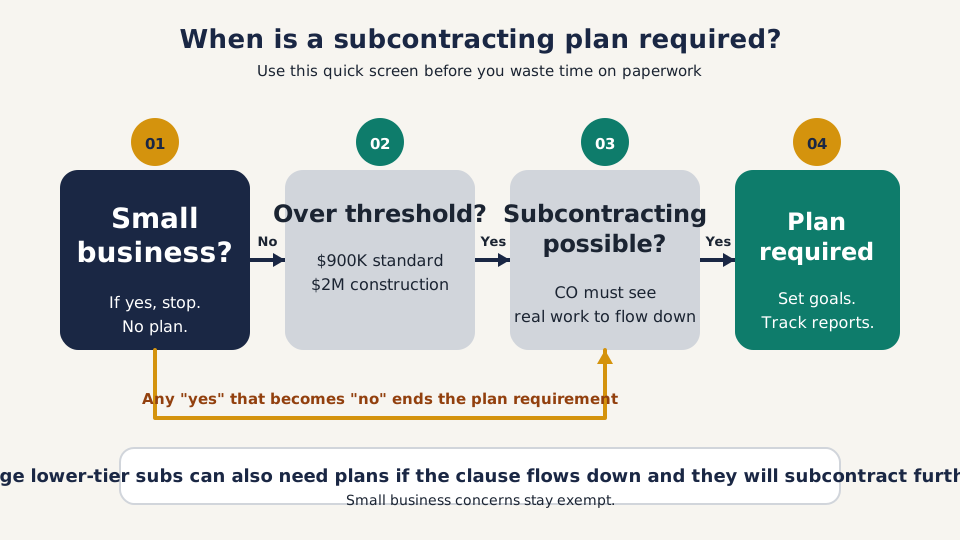
The short version is simple. FAR 19.702 says a subcontracting plan is generally required when three things are true at the same time:
- The awardee is other than small.
- The contract or covered modification exceeds $900,000, or $2 million for construction.
- The contracting officer determines that subcontracting opportunities exist.
That same FAR section also says plans are not required from small businesses. So if your company is small under the NAICS code assigned to the contract, stop there. No plan.
There is one wrinkle people miss. A large first-tier subcontractor can also get pulled into this rule. FAR 19.704 and FAR 52.219-9 require primes to flow the program down to lower-tier subcontractors, except small business concerns, when those subcontracts exceed the threshold and create further subcontracting possibilities.
| Situation | Plan required? | Why |
|---|---|---|
| Small business prime on a federal contract | No | FAR 52.219-9 does not apply to small business concerns |
| Large business prime over $900,000 | Usually yes | If subcontracting opportunities exist |
| Large business construction prime over $2 million | Usually yes | Same rule, higher construction threshold |
| Large first-tier subcontractor over threshold | Sometimes | If the prime flows the clause down and more subcontracting is expected |
One more point. Do not confuse a subcontracting plan with limitations on subcontracting. A small business set-aside prime may have no subcontracting-plan requirement and still be bound by separate rules on how much work it has to perform itself. SBA flags those as different issues in its prime and subcontracting guide. If you’re deciding which lane fits your business, read subcontracting vs prime contracting next.
Plain English: what the government is asking for
A subcontracting plan is the prime’s written promise about how it will spread eligible work to small businesses. It names the categories, sets percentage goals, identifies who inside the company owns the program, and creates a paper trail the agency can check later.
What has to be in the plan
This is not a one-page promise letter. FAR 19.704 lays out a long checklist, but most readers only need the pieces that actually drive behavior.
The plan has to set separate goals for small business overall, plus veteran-owned, service-disabled veteran-owned, HUBZone, small disadvantaged, and women-owned small business subcontractors. It also has to state how many total subcontract dollars are expected, what types of supplies or services will be subcontracted, how the prime will identify sources, who will administer the program, and what records the contractor will keep.
The flow-down piece matters too. The same FAR section says the prime has to include FAR 52.219-8 in subcontracts that offer further subcontracting opportunities and require qualifying large lower-tier subcontractors to adopt their own compliant plans. So this is not just a headquarters compliance memo. It can run down through the performance chain.
If the contractor sells commercial products or commercial services, the government often prefers a commercial plan instead of a contract-specific individual plan. That lets the contractor use one fiscal-year plan across its covered government business rather than rebuilding the paperwork for every award. If you’re a small business sub trying to read a prime’s posture, that distinction matters because some primes manage goals at the company level, not just at the single-contract level.
Why small subcontractors should care
Because this is where the opportunity comes from.
SBA says federal contracts awarded to other-than-small businesses over the threshold must contain a subcontracting plan, and it points vendors to the Directory of Federal Government Prime Contractors with a Subcontracting Plan. That directory is not just a list of big companies. It’s a list of companies that already signed paperwork saying they intend to subcontract to small businesses.
That is why our guide on finding prime contractors looking for subcontractors starts with planned subcontracting pressure, not brand recognition. A prime with a live contract, category-specific goals, and an internal small business program is a real lead. A famous contractor with no active fit for your NAICS code is just a logo.
SBA also says primes use the Small Business Search to find vendors. So if you are a sub, your first move is not asking whether you need a plan. Your first move is making sure your profile shows the right NAICS codes, certifications, keywords, and performance history. Otherwise the prime cannot find you when it goes looking for firms that help it hit those goals.
And if you hold a certification, say so clearly. You don’t need a certification to subcontract, but primes do have category-specific goals. That makes a credible WOSB, SDVOSB, 8(a), or other certified firm more useful to them than a generic profile with no socioeconomic status attached.
Reporting and enforcement in 2026
This is where a lot of primes get sloppy. The plan is not filed away and forgotten.
SBA says any prime contractor with a subcontracting plan can be selected for a compliance review. If the review finds deficiencies, the contractor has to submit a corrective action plan, and unresolved failures can lead to negative past performance and liquidated damages under FAR 52.219-16.
The key legal nuance: missing a goal is not automatically the same as failing in good faith. FAR 19.702 and Subpart 19.7 make the standard good-faith effort, not perfection. But if a contractor cannot show real outreach, tracking, flow-down compliance, or a serious attempt to use the subs it named in its proposal, the government has leverage.
There is also a current operations wrinkle. The FAR text and SBA guidance still refer to eSRS, but SAM.gov says eSRS was retired on February 20, 2026, and subcontracting reporting now runs inside SAM.gov. Treat that as a systems change, not a reason to ignore the reporting duty. If you’re a prime, get your SAM roles sorted early. If you’re a subcontractor, ask the prime how it wants your UEI, size status, and certification data delivered so your dollars can actually be counted.
If you’re a small business reading all this and wondering what to do next, keep it simple. Don’t draft a subcontracting plan for yourself unless a real contract clause makes you do it. Use the time to sharpen your profile, target primes with active subcontracting pressure, and show up ready to solve a specific problem. That’s what gets you on a team.