Government set-aside certifications: which one is right for your business?
Updated February 2026. This guide reflects the SBA’s full takeover of veteran certifications (VetCert) and the 8(a) social disadvantage narrative requirement following the Supreme Court’s Ultima Services Corp. v. USDA decision.
The federal government sets aside a percentage of its contract dollars for specific categories of small businesses. In FY2024, that meant $183.5 billion going to small businesses — 28.76% of all federal contract spending. The certifications that unlock those set-aside contracts are free to obtain, and each one opens a pool of contracts that fewer businesses can compete for.
But not every certification is worth your time. Some have straightforward eligibility and real contract volume. Others have narrow eligibility, thin pipelines, or bureaucratic costs that outweigh the benefits for most small businesses. This guide breaks down each certification so you can decide which ones to pursue based on your actual situation, not a consultant’s sales pitch.
If you haven’t registered in SAM.gov yet, do that first. The complete guide to registering for government contracts covers every step. You need an active SAM.gov registration before any set-aside certification matters.
What set-asides actually are
Plain English: set-aside contracts
A set-aside is a government contract where only businesses with a specific certification can bid. If a contract is “set aside for 8(a) firms,” only businesses with 8(a) certification can submit a proposal. Fewer bidders means better odds. That’s the whole point.
A set-aside is a contract that’s restricted to businesses holding a specific certification. When a contracting officer sets aside a contract for 8(a) firms, only certified 8(a) firms can bid. When a contract is set aside for WOSBs, only certified women-owned small businesses compete.
The logic: the federal government has statutory goals for how much money goes to different categories of small businesses. If contracting officers just opened every contract to full competition, large companies would dominate even more than they already do. Set-asides level the field by creating pools where only certified businesses compete.
The government’s annual goals:
| Category | Goal | FY2024 Actual | FY2024 Dollars |
|---|---|---|---|
| All small business | 23% | 28.76% | $183.5 billion |
| Small disadvantaged business (includes 8(a)) | 13% | 12.27% | $78.3 billion |
| Women-owned small business (WOSB) | 5% | 4.97% | $31.7 billion |
| Service-disabled veteran-owned (SDVOSB) | 5% | 5.14% | $32.8 billion |
| HUBZone | 3% | 2.75% | $17.6 billion |
Those dollar figures are the total contract value going to each category, not just set-aside contracts. A certified 8(a) firm can win both set-aside and full-and-open contracts. The certification expands what you can compete for — it doesn’t limit you.
The five certifications, side by side
Before diving into each one, here’s the comparison table. I’ll explain each row in the sections that follow.
| 8(a) | HUBZone | WOSB/EDWOSB | SDVOSB | MBE (state) | |
|---|---|---|---|---|---|
| Who qualifies | Socially & economically disadvantaged owners | Businesses in designated HUBZone areas | 51%+ women-owned | 51%+ owned by service-disabled vet | Varies by state |
| Certifying agency | SBA | SBA | SBA | SBA (VetCert) | State agencies |
| Application cost | Free | Free | Free | Free | $0-$500 |
| Processing time | ~90 days | 60-90 days | 30-90 days | 60-90 days | Varies |
| Duration | 9 years (lifetime limit) | 3 years (renewable) | 3 years (renewable) | No expiration (annual recert) | 1-3 years |
| Sole-source threshold | $4.5M / $7M mfg | $4.5M / $7M mfg | $4.5M / $7M mfg | $4.5M / $7M mfg | N/A |
| FY2024 contract volume | $78.3B (SDB category) | $17.6B | $31.7B | $32.8B | State-level only |
| Stacks with others? | Yes | Yes | Yes | Yes | Federal only with SBA |
| Biggest advantage | Sole-source contracts | Less competition | Growing pool | Strong veteran preference | State contracts |
| Biggest drawback | 9-year limit, heavy oversight | Location + employee rules | Narrower NAICS eligibility | Disability documentation | No federal benefit |
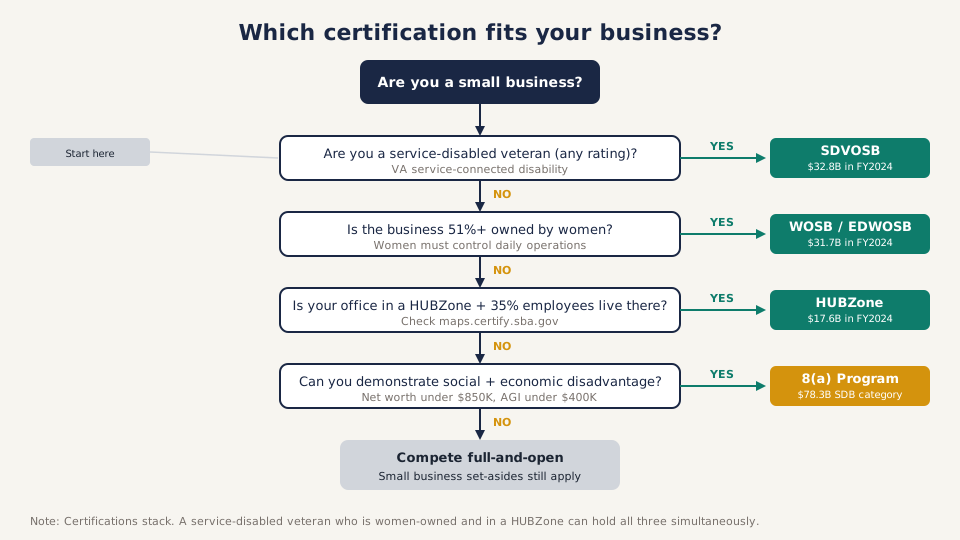
Now the details.
8(a) Business Development Program
Plain English: 8(a) program
The 8(a) program is a nine-year business development program run by the SBA. It’s designed for businesses owned by people who are socially and economically disadvantaged. The biggest perk: sole-source contracts, meaning the government can hand you a contract worth up to $4.5 million without any competition at all. You can only participate once in your lifetime.
The 8(a) program is the most powerful set-aside certification and the hardest to get. It’s a nine-year program — once in your lifetime — that gives you access to sole-source contracts (no competition at all) up to $4.5 million for services and $7 million for manufacturing.
Eligibility requirements:
- At least 51% owned and controlled by U.S. citizens who are socially and economically disadvantaged
- Personal net worth of $850,000 or less (excluding your primary residence and the business itself)
- Adjusted gross income of $400,000 or less
- Total assets of $6.5 million or less
- Must be a small business under SBA size standards
- Must demonstrate potential for success (at least two years in business preferred)
- Must demonstrate “good character”
- Cannot have previously participated in the 8(a) program
What “socially disadvantaged” means now — and why it changed. The 8(a) program used to presume that members of certain racial and ethnic groups (Black Americans, Hispanic Americans, Asian Pacific Americans, and others) were socially disadvantaged. That meant those applicants didn’t have to individually prove disadvantage — they just checked a box.
That presumption is gone. In 2023, the Supreme Court decided Ultima Services Corp. v. USDA, which directly challenged the race-based presumption in the 8(a) program. A federal district court enjoined the SBA from using the presumption, and the SBA subsequently suspended it. As of 2024, no applicant — regardless of background — can rely on a presumption of social disadvantage. Every applicant must submit a social disadvantage narrative.
Plain English: the social disadvantage narrative
A social disadvantage narrative is a written statement (usually 2-4 pages) describing specific, concrete experiences where you personally were treated differently or faced obstacles in business because of your race, ethnicity, gender, disability, or other social circumstances. It is not a general diversity statement. The SBA wants specific incidents: a bank that denied your loan application while approving comparable applications from others, a contract you were excluded from, a professional association that blocked your membership. Vague statements get rejected. Specific, documented experiences pass.
What the narrative must cover. The SBA evaluates social disadvantage narratives against these criteria:
- The disadvantage must stem from circumstances beyond your control (not just business setbacks)
- It must be based on your identity — race, ethnicity, gender, disability, long-term residence in an isolated environment, or other objective distinguishing features
- It must have negatively impacted your entry into or advancement in business
- The incidents must be described with enough specificity that they can be evaluated — general statements about societal discrimination do not meet the standard
The SBA adjudicates these narratives individually. An application without a strong narrative, or with a narrative that doesn’t meet the specificity standard, will be declined on social disadvantage grounds even if the applicant meets all other eligibility criteria.
The nine-year structure. Years 1-4 are the “developmental stage” — the SBA focuses on helping your business grow, and you have full access to 8(a) sole-source contracts. Years 5-9 are the “transitional stage,” where the SBA gradually weans you off program benefits. You’re required to earn increasing percentages of your revenue from non-8(a) sources: 15% in year five, ramping to 50% by year nine.
Is it worth it? If you qualify and get accepted, the sole-source contract access alone can transform a small business. A single $4 million sole-source contract awarded without competition is the kind of revenue event that takes most small businesses years to achieve through full-and-open bidding.
But the application is extensive, the program has significant reporting requirements, and the current approval rate is far lower than historical norms. If you’re considering 8(a), talk to your local APEX Accelerator (formerly PTAC) before applying. They’ll review your application for free and tell you honestly whether it’s ready. More applications get rejected for missing documents than for ineligibility — the top rejection reasons are failure to submit complete corporate documents, incomplete tax returns, and financial statements that don’t add up.
Where to apply: MySBA Certifications at certify.sba.gov
HUBZone certification
Plain English: HUBZone
HUBZone stands for Historically Underutilized Business Zone. If your office is in an economically disadvantaged area and at least 35% of your employees live in one, you can get certified. The payoff: less competition on set-aside contracts and a 10% price preference in open competitions, meaning your bid can be 10% higher than a non-HUBZone competitor and still win.
HUBZone stands for Historically Underutilized Business Zone. If your business is physically located in a designated HUBZone area and at least 35% of your employees live in a HUBZone, you qualify.
Eligibility requirements:
- Principal office must be located in a HUBZone (check the map at maps.certify.sba.gov/hubzone/map)
- At least 35% of employees must reside in a HUBZone
- Must be a small business under SBA size standards
- Must be at least 51% owned and controlled by U.S. citizens, a Community Development Corporation, an agricultural cooperative, an Alaska Native Corporation, a Native Hawaiian organization, or an Indian tribal government
What counts as a HUBZone. HUBZone designations are based on census tract data and cover areas with low median income, high unemployment, or other economic disadvantage indicators. Rural areas, Native American lands, and certain urban census tracts qualify. The SBA updates the map periodically — areas can gain or lose HUBZone designation.
The location catch. Your principal office has to be in a HUBZone, and you have to be able to prove it’s a real office where real work happens. A virtual mailbox in a HUBZone doesn’t count. And 35% of your employees — not subcontractors, employees — must live in a HUBZone. For a 10-person company, that’s 4 employees.
If your area loses HUBZone designation after you’re certified, you get a three-year grace period for the location requirement. But new employee hires during that period still need to meet residency requirements.
Contract volume. HUBZone attracted $17.6 billion in FY2024 — the smallest of the four federal set-aside categories, and the government missed its 3% goal (actual: 2.75%). That’s both a downside (smaller pool) and an upside (less competition for what’s there). HUBZone set-asides also get a 10% price evaluation preference in full-and-open competitions, meaning your bid can be 10% higher than a non-HUBZone competitor and still win.
Is it worth it? If you already meet the location and employee requirements, absolutely. The application is free, the certification is renewable every three years, and the 10% price preference is a real competitive edge. If you’d have to relocate your office or restructure your workforce to qualify, the math probably doesn’t work unless you’re chasing a specific, large HUBZone set-aside contract.
Where to apply: MySBA Certifications at certify.sba.gov
WOSB and EDWOSB certification
Plain English: WOSB and EDWOSB
WOSB (Women-Owned Small Business) and EDWOSB (Economically Disadvantaged Women-Owned Small Business) are free SBA certifications for companies that are at least 51% owned and controlled by women. EDWOSB is the same thing plus a financial cap (net worth under $850K). The EDWOSB designation opens more contract categories, so if you qualify for both, go for EDWOSB. For the full application walkthrough, see the WOSB/EDWOSB certification guide.
The Women-Owned Small Business (WOSB) and Economically Disadvantaged Women-Owned Small Business (EDWOSB) certifications create set-aside opportunities for women-owned firms in industries where women are underrepresented in federal contracting.
Eligibility requirements (WOSB):
- At least 51% owned and controlled by one or more women who are U.S. citizens
- Women must manage the daily operations and make long-term business decisions
- Must be a small business under SBA size standards
- NAICS code must be in an industry where WOSBs are underrepresented (the SBA publishes this list)
EDWOSB adds one more requirement: The women owners must also be economically disadvantaged, meaning personal net worth under $850,000 (excluding primary residence), adjusted gross income under $400,000, and total assets under $6.5 million — the same economic thresholds as the 8(a) program.
Why does the EDWOSB distinction matter? WOSB set-asides are available in industries where women are “substantially underrepresented.” EDWOSB set-asides are available in a broader set of industries where women are simply “underrepresented.” The EDWOSB designation opens more NAICS codes for set-aside eligibility.
The NAICS limitation. This is the biggest constraint most people don’t know about. WOSB and EDWOSB set-asides only apply in specific NAICS codes where the SBA has determined women are underrepresented. If your primary NAICS code isn’t on the list, the certification doesn’t help you with set-aside contracts (though it still counts toward agencies’ WOSB contracting goals in full-and-open competitions).
Contract volume. WOSB-category firms received $31.7 billion in FY2024 (4.97% of federal contracting). The government narrowly missed its 5% goal. The pool is real, but much of that $31.7 billion went to firms winning full-and-open contracts, not set-asides. Actual WOSB-specific set-aside contract dollars were closer to $1.1 billion.
A note about “women-owned business grants.” If you searched for grants and ended up here, here’s the reality: the federal government does not offer grants specifically for women-owned businesses to start or grow a company. The WOSB program is about contract set-asides — you earn revenue by performing work for the government, not by receiving a grant check. The SBA offers loan programs and counseling through Women’s Business Centers, but those aren’t grants either. The 8,100 monthly Google searches for “women owned small business grants” are chasing something that essentially doesn’t exist at the federal level.
Is it worth it? If you meet the ownership requirements and your NAICS codes are on the eligible list, yes. The application is free, the SBA processes it in 30-90 days, and it opens doors that are otherwise closed. The certification also stacks with others — you can hold WOSB and 8(a) simultaneously, for example. Check the NAICS eligibility list before applying so you know whether set-asides will actually be available for your type of work.
Where to apply: MySBA Certifications at certify.sba.gov, or through an SBA-approved third-party certifier like WBENC or NWBOC.
SDVOSB certification (VetCert)
Plain English: SDVOSB
SDVOSB stands for Service-Disabled Veteran-Owned Small Business. If you’re a veteran with any service-connected disability rating (even 0%) and you own at least 51% of your business, you qualify. The certification is free, has no time limit, and gives you access to sole-source contracts up to $4.5 million. The SBA manages verification through its VetCert program — the VA no longer administers veteran business certifications.
The Service-Disabled Veteran-Owned Small Business certification is for firms owned by veterans with a service-connected disability rating from the VA.
Eligibility requirements:
- At least 51% owned and controlled by one or more service-disabled veterans
- The veteran must have a service-connected disability rating from the VA (any percentage — even 0% if it’s service-connected)
- The veteran must manage daily business operations and make long-term decisions
- Must be a small business under SBA size standards
VetCert is now fully managed by the SBA. As of January 2023, the SBA took over all veteran business certification from the Department of Veterans Affairs. The VA’s Center for Verification and Evaluation (CVE) no longer certifies SDVOSB or VOSB firms. All applications, renewals, and appeals go through the SBA.
The old VA portal (vetbiz.va.gov) has been retired. The VetCert program now lives at the SBA’s MySBA Certifications platform. If you were previously verified by the VA’s CVE and your certification has lapsed, you must reapply through SBA — your old VA certification does not automatically transfer.
The VetCert process through SBA requires:
- DD-214 (Certificate of Release or Discharge from Active Duty)
- VA disability rating letter showing service-connected disability
- Corporate documents proving ownership and control (operating agreement, articles, stock certificates as applicable)
- Government-issued photo ID for the qualifying veteran
Processing takes 60-90 days for a complete application.
Contract volume. SDVOSB-category firms received $32.8 billion in FY2024, exceeding the 5% government-wide goal for the first time at the elevated threshold. That’s real money and real demand. The VA itself is one of the largest buyers of SDVOSB set-aside contracts, but every federal agency has an SDVOSB contracting goal.
The SDVOSB set-aside pool also includes sole-source authority up to $4.5 million for services and $7 million for manufacturing — the same thresholds as 8(a).
Is it worth it? If you’re a service-disabled veteran who owns a business, this is one of the strongest certifications available. The contract volume is substantial, the certification has no time limit (just annual recertification), and the sole-source authority gives you access to noncompetitive awards. The application is free and the VetCert process, while more involved than the old self-certification, is straightforward.
Can you hold SDVOSB and 8(a)? Yes. A service-disabled veteran who also qualifies as socially and economically disadvantaged can hold both certifications simultaneously, which means eligibility for both SDVOSB and 8(a) set-asides. This combination is one of the most powerful positions in government contracting.
Where to apply: SBA MySBA Certifications at certify.sba.gov (the old VA portal at vetcert.va.gov has been retired)
State-level MBE, WBE, and DBE certifications
State Minority Business Enterprise (MBE), Women’s Business Enterprise (WBE), and Disadvantaged Business Enterprise (DBE) certifications are separate from federal programs. They unlock state and local government set-aside contracts, and the eligibility criteria, application process, and administering agencies vary by state.
Key differences from federal certifications:
- State certifications don’t help with federal contracts (and federal certifications don’t help with most state set-asides)
- Each state has its own certifying agency and application
- Some states charge application fees ($50 to $500 depending on the state)
- Eligibility thresholds for “disadvantaged” may differ from federal standards
- Some states accept reciprocity from SBA or DOT certifications, reducing duplicate paperwork
Is it worth it? If you do any work with state or local governments, check your state’s programs. State-level set-asides can be significant — states like Texas (HUB certification), California (SB and DVBE), New York (MWBE), and Florida have active programs with real contract volume. And the competition is often thinner than federal set-asides because fewer businesses bother with state-level certifications.
The cost-benefit math depends on how much state/local work you pursue. If you’re exclusively focused on federal contracting, state certifications don’t help you. If you’re bidding on both federal and state contracts, stack both.
Can you hold multiple certifications?
Yes. Certifications stack, and holding multiple certifications makes you eligible for more set-aside pools. Common combinations:
- 8(a) + SDVOSB: Service-disabled veteran who is also socially and economically disadvantaged. Eligible for both program set-asides.
- WOSB + 8(a): Woman-owned firm where the owner qualifies as socially and economically disadvantaged. Eligible for both.
- HUBZone + WOSB: Woman-owned firm in a HUBZone area. Eligible for both, plus the 10% price preference.
- Any federal cert + state MBE/WBE: Federal and state certifications are independent systems. Hold both to access both pools.
There’s no penalty for holding multiple certifications. The only constraint is that you must actually meet the eligibility requirements for each one simultaneously. If your net worth grows above $850,000, you lose the economic disadvantage element of 8(a) and EDWOSB even if you still qualify for WOSB and SDVOSB.
The mistakes that get applications rejected
The SBA publishes the most common reasons certification applications are declined or returned. Most of them aren’t about eligibility — they’re about paperwork:
- Missing corporate documents. Articles of incorporation, bylaws, operating agreements, meeting minutes, stock certificates, certificates of good standing. If any are missing, the application goes to the back of the line.
- Incomplete tax returns. The SBA wants complete returns including all schedules and attachments. A 1040 without the K-1s from your business won’t pass.
- Financial statements that don’t add up. If your balance sheet doesn’t tie to your tax returns, the SBA sends it back.
- Corporate documents that contradict eligibility. This is the sneaky one. Many business owners use a lawyer to create their corporate documents, but the lawyer uses a generic template that doesn’t give the qualifying individual the control the SBA requires. If your bylaws give your non-disadvantaged business partner veto power over major decisions, the SBA will flag it — even if you own 51%.
- Not demonstrating full-time dedication. The qualifying individual has to be running the business day to day. If you’re listed as CEO but your LinkedIn shows you’re a full-time employee somewhere else, expect questions.
The fix for all of these: before you submit anything, take your complete application package to your local APEX Accelerator. They review certification applications for free, and they’ve seen enough rejected applications to spot problems before the SBA does.
Finding your APEX Accelerator
APEX Accelerators (formerly Procurement Technical Assistance Centers) are federally funded offices that help small businesses with government contracting — for free. Every state has at least one. They’ll review your certification application, help you find contracts to bid on, and assist with proposal writing. Find yours at apexaccelerators.us.
The honest “is it worth it?” framework
Before applying for any certification, answer these three questions:
1. Do you actually qualify? Read the eligibility requirements above. If you’re on the edge — net worth close to $850,000, or your business location is one block outside a HUBZone — the application process will expose that, and you’ll waste months.
2. Is there contract volume in your NAICS codes? Having a certification means nothing if agencies aren’t setting aside contracts for the type of work you do. Search sam.gov for set-aside contracts in your NAICS codes. Filter by set-aside type (8(a), WOSB, SDVOSB, HUBZone) and look at the last 12 months of awards. If you see active procurement, the certification has value. If you see nothing, the certification is a credential that doesn’t open any doors.
3. Are you ready to bid? A certification doesn’t generate revenue on its own. You still need to find opportunities, write proposals, and perform the work. If you’re not registered in SAM.gov, don’t have a capability statement ready, and haven’t identified your target agencies, get those fundamentals in place first. The certification is a force multiplier — it multiplies zero if the fundamentals aren’t there.
If you answered yes to all three, apply. The applications are free, the certifications expand your opportunities, and the math gets better every year as the government continues pushing contract dollars toward small businesses.
Your SAM.gov registration is your entry ticket. Certifications are the upgrade. Start with whichever one you clearly qualify for, learn how the set-aside market works with that certification, and add others as your business grows into them.
Next step: You’re registered, you know which certifications fit. Now you need to start finding and winning contracts. When the proposal writing guide goes live, that’s your next read. In the meantime, make sure your SAM.gov registration is current — an expired registration means none of these certifications matter.
If you’re interested in WOSB or EDWOSB specifically, the complete WOSB/EDWOSB application walkthrough covers every document, every step, and every timeline detail. And if you’re not ready to bid as a prime contractor, subcontracting is a lower-barrier way to get started in government work — we’ll cover that path in a future guide.