WOSB and EDWOSB certification: the complete application walkthrough
WOSB (Women-Owned Small Business) and EDWOSB (Economically Disadvantaged Women-Owned Small Business) certifications give your company access to federal contracts set aside for women-owned firms. In FY 2024, the federal government awarded $26.6 billion to WOSBs across nearly 14,000 companies. Certification is free through the SBA, requires proof of 51% women ownership and women-led management, and takes 90 days to several months to process.
If you searched for “women-owned small business grants” and ended up here, keep reading — what you’re actually looking for is almost certainly federal contracts, not grants. That distinction matters, and we’ll get to it.
This article covers who qualifies, what documents you need, how to apply through the SBA portal, and when the EDWOSB designation is worth the extra paperwork. If you haven’t figured out which set-aside certifications fit your business yet, start with the set-aside certifications guide for the full comparison.
WOSB vs EDWOSB: what’s the difference?
Plain English: WOSB vs EDWOSB
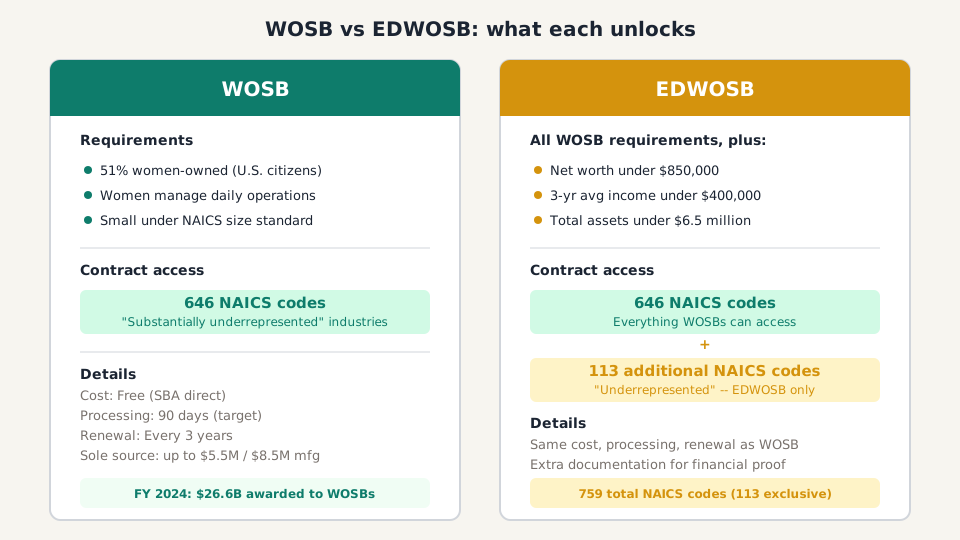
Both are SBA certifications for women-owned businesses, and both are free to get. The difference comes down to money. WOSB is for any qualifying women-owned firm. EDWOSB adds a financial requirement: the women owners must have a personal net worth under $850,000, income under $400,000, and total assets under $6.5 million. In return, EDWOSB opens 113 additional contract categories that regular WOSB can’t access. If you meet the financial caps, always apply for EDWOSB — you get everything WOSB offers plus more.
Both certifications exist under the WOSB Federal Contract Program, which targets industries where women-owned businesses are underrepresented in federal procurement. The federal government’s statutory goal is to award at least 5% of all contracting dollars to WOSBs each year. In FY 2024, the actual number was 3.44% — still short of the target.
WOSB certification qualifies your business to compete for contracts set aside in 646 NAICS codes designated as “substantially underrepresented” by women-owned firms.
EDWOSB certification qualifies you for those same 646 codes plus an additional 113 NAICS codes designated as “underrepresented.” EDWOSB requires the qualifying women to meet specific financial thresholds on top of the standard WOSB requirements.
In practical terms: EDWOSB opens more doors. If you meet the financial thresholds, there’s no reason not to apply for it.
Eligibility requirements
WOSB (all three must be met)
Ownership. The business must be at least 51% unconditionally and directly owned by one or more women who are U.S. citizens. “Directly” means through the individual, not through a trust, holding company, or other entity (with very limited exceptions).
Control. One or more women must manage day-to-day operations and make long-term strategic decisions. The qualifying woman generally must work full-time at the business during normal hours. As of January 2025, she must notify the SBA before taking on outside employment after certification.
Size. The business must qualify as small under the SBA size standard for the applicable NAICS code. Size standards vary by industry — check yours at sba.gov before applying.
EDWOSB (WOSB requirements plus financial thresholds)
The qualifying woman must meet all three of these caps:
| Threshold | Current limit |
|---|---|
| Personal net worth | Less than $850,000 |
| Adjusted gross income (3-year average) | $400,000 or less |
| Fair market value of all assets | $6.5 million or less |
These thresholds were increased in December 2022 (up from $750K / $350K / $6M). They’re adjusted periodically for inflation.
A few details that matter: your ownership interest in the EDWOSB business itself is excluded from the net worth calculation. So is the equity in your primary residence and funds in retirement accounts. Income from the EDWOSB can be excluded from the AGI calculation if it was reinvested in the business or used for taxes. But the $6.5 million asset cap includes your home and the business value.
The application process
SBA certification is free. You apply through wosb.certify.sba.gov. Third-party certifiers also exist (we’ll cover those below), but SBA direct is the default path.
Before you start
Get your SAM.gov registration in order. Your SAM.gov profile must be active with a matching UEI, EIN, and MPIN. Registration must be set to “All Awards” — not “Loans and Grants.” If your SAM.gov registration isn’t current, the registration guide covers every step.
Create a Login.gov account if you don’t have one. This is how you’ll access the MySBA Certifications portal.
Gather your documents. Everything must be uploaded as individual PDFs (not zipped), each under 25MB. Here’s what you need:
Required documents
Business formation:
- Articles of incorporation (signed, dated, with state filing seal)
- Operating agreement or bylaws
- Stock certificates (front and back) if applicable
- DBA/trade name certificate if applicable
- Certificate of good standing if operating in a different state than incorporation
- Board meeting minutes showing current board members
Personal identity (for each qualifying woman):
- Proof of U.S. citizenship: state-issued birth certificate, certificate of naturalization, or unexpired passport
- Proof of name change if applicable (marriage license, court order)
- Resume listing current ownership roles and prior work experience
Financial:
- Three years of business tax returns with all schedules
- Three years of W-2s, 1099s, or a letter explaining income sources
EDWOSB additional documents:
- Personal financial statements
- Three years of personal tax returns (to verify AGI)
- Documentation of personal assets (to verify fair market value under $6.5M)
- Documentation of personal net worth under $850K
Step by step
- Visit wosb.certify.sba.gov and review the Preparation Checklist
- Log in and claim your business on the WOSB Dashboard
- Initiate the WOSB Application
- Complete the Women Ownership section
- Complete the Control section
- If applying for EDWOSB, complete the Financial section
- Each qualifying woman completes the Individual Contributor questionnaire
- Upload all documents per the checklist
- Attest to the Program Self-Certification Summary
- Submit
Before you submit
Double-check that every document is uploaded as an individual PDF (not bundled), your SAM.gov profile matches your application exactly (name, address, EIN), and every qualifying woman has completed her Individual Contributor questionnaire. Missing documents are the most common cause of delays.
How long does it take?
The SBA’s regulatory target is 90 calendar days after receiving a complete application. The reality is longer. Backlogs have pushed some applications to several months. The SBA recently removed the requirement to notify applicants within 15 days whether their application is complete, which makes tracking your status harder.
If speed matters, third-party certifiers may be faster.
Third-party certifiers
The SBA is not the sole certifier. Four SBA-approved third-party certifiers can also certify your WOSB/EDWOSB status:
| Certifier | Cost | Notes |
|---|---|---|
| NWBOC (National Women’s Business Owners Corporation) | $400+ | Well-established, widely recognized |
| WBENC (Women’s Business Enterprise National Council) | Free for WBENC members | WOSB only — not EDWOSB |
| USWCC (U.S. Women’s Chamber of Commerce) | $275-$350 | |
| EPHCC (El Paso Hispanic Chamber of Commerce) | Varies | Less commonly used |
What changed: Before October 2020, businesses could self-certify as WOSB/EDWOSB — just check a box and go. That ended when the SBA implemented the requirement for actual certification. Now you must go through the SBA directly or use one of these four approved certifiers.
As of January 2025, the applicant firm (not the third-party certifier) is responsible for uploading all required documents to the SBA portal, even when using a TPC. The certifier validates your eligibility; you handle the paperwork.
Which NAICS codes qualify?
The SBA has identified 759 NAICS codes eligible for the WOSB program:
- 646 codes (substantially underrepresented): Both WOSBs and EDWOSBs can compete
- 113 codes (underrepresented): Only EDWOSBs can compete
Each federal contract is assigned a NAICS code. If that code is on the eligible list, the contracting officer may set aside the procurement for WOSBs (or EDWOSBs only, for the 113 underrepresented codes). For set-asides, the contracting officer needs a reasonable expectation that at least two WOSBs will submit offers at a fair market price. For sole source awards, the ceiling is $8.5 million for manufacturing and $5.5 million for all other NAICS codes.
The NAICS eligibility lists were last updated for the 2022 NAICS revision. Check the current lists at sba.gov before assuming your industry qualifies.
One thing to know: WOSB set-asides are discretionary, not mandatory. Contracting officers may set procurements aside for WOSBs — they’re not required to. That’s why only about $1.3 billion of the $26.6 billion awarded to WOSBs in FY 2024 came through the dedicated WOSB set-aside program. Most of it came through general small business set-asides and open competition.
The grants myth
If you searched “women owned small business grants,” you’re not alone — that phrase gets over 8,000 searches a month. But here’s the reality: the SBA does not provide grants for starting or expanding a business. They say this explicitly on their website.
What the SBA does offer:
- Loans (7(a), 504, microloans) — the primary capital tool
- Federal contracts — the real opportunity WOSB certification unlocks
Government grants for small businesses exist in very narrow categories: SBIR/STTR grants for scientific R&D, STEP grants for state export programs, and community grants to nonprofit organizations promoting entrepreneurship. None of these are “apply for free money to grow your business” programs.
There are also private-sector grants and competitions (Amber Grant, IFundWomen, various corporate programs), but these are typically small ($500 to $10,000) and have nothing to do with government certification.
The money for women-owned businesses in federal procurement is in contracts — $26.6 billion in FY 2024. That’s what WOSB certification gives you access to. Grants are a rounding error by comparison.
Renewal and ongoing requirements
WOSB/EDWOSB certification lasts three years. The SBA eliminated the old annual attestation requirement in May 2023, so you no longer need to update your status every year.
The SBA sends renewal notifications starting 120 days before your three-year anniversary. You can begin recertification at the 90-day mark.
Between renewals, you must notify the SBA of any material changes affecting eligibility within 30 calendar days. If your ownership structure changes, if a qualifying woman leaves the business, or if your EDWOSB financial situation crosses a threshold, report it.
Keep your SAM.gov registration updated annually — that’s a separate requirement from WOSB recertification.
Current extension: If your three-year renewal date falls between June 2024 and May 2026, the SBA has granted a one-year extension of eligibility. Check wosb.certify.sba.gov for the latest on whether this remains in effect.
Recent changes worth knowing
The WOSB program has been through significant regulatory changes in the last two years:
January 2025 final rule:
- Qualifying women must notify SBA before taking outside employment after certification
- Document upload responsibility shifted from third-party certifiers to the applicant
- SBA removed the 15-day application completeness notification
- Decertified firms must notify contracting officers and update SAM.gov within 2 business days
- VOSB/SDVOSB certification documentation can support a WOSB application
December 2022 threshold increases:
- EDWOSB net worth cap raised from $750K to $850K
- AGI cap raised from $350K to $400K
- Asset cap raised from $6M to $6.5M
May 2023 recertification change:
- Annual attestation eliminated, replaced with three-year cycle
Is it worth it?
The certification itself costs nothing through the SBA. The time investment is real — gathering documents, completing the application, and waiting months for processing. But the access it provides is substantial.
The $26.6 billion awarded to WOSBs in FY 2024 came through multiple channels: WOSB-specific set-asides, general small business set-asides, 8(a) programs, and open competition. Certification doesn’t guarantee contracts, but it qualifies you for set-aside competitions where the bidder pool is smaller and your chances are better.
If you meet the EDWOSB financial thresholds, apply for EDWOSB. The additional 113 NAICS codes and the sole-source authority are worth the extra documentation. If your net worth, income, or assets exceed the thresholds, standard WOSB certification still opens 646 NAICS codes.
The WOSB program hasn’t hit its 5% goal yet — the government awarded 3.44% to WOSBs in FY 2024, up from 3.13% in FY 2021. The trajectory is upward, and agencies are under pressure to close the gap. More set-asides are coming.
Your next move is getting your documents together and starting the application at wosb.certify.sba.gov. If you’re also considering joint venture structures to bid on larger contracts, WOSB certification makes your JV eligible for WOSB-specific set-asides — another reason to get certified before you start pursuing teaming opportunities.
If you’re still deciding which certifications are right for your business, the set-aside certifications guide compares every federal certification side by side — 8(a), HUBZone, WOSB, SDVOSB, and state-level programs. WOSB stacks with other certifications, so you may qualify for more than one.