SBA Mentor-Protege Program: what subcontractors need to know
The SBA Mentor-Protege Program pairs small businesses with experienced government contractors so the small business can build capacity, form joint ventures, and compete for contracts it couldn’t win on its own. The protege keeps its small business size status even while partnering with a much larger mentor. The joint venture can bid on set-aside contracts using the mentor’s past performance, and the protege gets credit for that work going forward.
If you’ve been subcontracting on federal contracts and you’re ready to move toward prime work but don’t have the past performance or resources to bid solo, this program is designed for exactly your situation.
What the program actually does
The SBA Mentor-Protege Program (MPP) creates a formal, SBA-approved relationship between two businesses: a mentor (usually a larger, experienced contractor) and a protege (a small business). The mentor agrees to help the protege develop its capabilities over a defined period, and in exchange, they can form a joint venture that competes as a small business.
Plain English: mentor-protege agreement
Think of it like a business apprenticeship with a legal structure. The mentor teaches you how to win and perform federal contracts. In return, you bring your small business size status to a joint venture, which lets the mentor compete for set-aside contracts they couldn’t touch alone. Both sides benefit. The SBA oversees the whole arrangement to make sure the protege is actually getting something out of it.
The program merged two older programs (the 8(a) Mentor-Protege Program and the All Small Mentor-Protege Program) into a single MPP in November 2020. Any small business can apply as a protege now — you don’t need 8(a) certification or any other set-aside to qualify.
Here’s what the mentor can provide:
- Management and technical assistance. Help with business operations, accounting systems, HR policies, and the internal infrastructure agencies expect from a prime contractor.
- Financial assistance. Loans, equity investments, or bonding support. This isn’t charity — it’s an investment the mentor makes in the relationship.
- Business development. Identifying opportunities, building capture strategies, and writing proposals. The mentor shows you how they actually win work.
- General and administrative support. Office space, equipment, IT systems, and back-office support that a small business might not have.
The key word is “capacity building.” The SBA wants to see that the protege is learning and growing, not just riding the mentor’s coattails. Annual reviews check whether the protege is actually developing new capabilities.
Why subcontractors should care
If you’ve been working as a sub, you already know the ceiling. You do good work, the prime gets paid, the prime pays you. But the prime keeps the government relationship, the past performance credit, and the margin. You’re building their track record, not yours.
The Mentor-Protege Program breaks that pattern in three ways.
You get prime-level past performance
When a mentor-protege joint venture wins and performs a contract, the protege can use that JV past performance on future bids — including solo bids after the relationship ends. That’s the single biggest barrier to going prime, and this program gives you a structured way past it.
If you’ve read about joint ventures vs teaming agreements, you know that past performance credit is one of the main reasons to form a JV. The Mentor-Protege Program makes JV formation easier and adds SBA oversight to keep both sides honest.
Your size status is protected
Normally, if a small business forms a joint venture with a large business, the SBA considers them “affiliated” — meaning the small business takes on the large business’s size and loses its small business status. That kills set-aside eligibility.
The Mentor-Protege Program creates an exception. An SBA-approved mentor-protege JV is exempt from affiliation rules. The protege’s size status determines the JV’s eligibility for set-aside contracts. A 15-person IT firm with an approved mentor-protege agreement can form a JV with a 5,000-person defense contractor and still bid on small business set-asides.
You can compete for set-asides you already qualify for
The JV can pursue any set-aside contract for which the protege qualifies. If you hold WOSB certification, the JV can bid on WOSB set-asides. If you’re 8(a) certified, the JV can bid on 8(a) sole-source and competitive contracts. Same for SDVOSB, HUBZone, and general small business set-asides.
That’s a big deal. Your certifications become more valuable because you can now back them with the mentor’s technical capabilities, past performance, and resources. You’re no longer limited to the contracts you can perform alone.
Who qualifies
Protege requirements:
- Must be a small business under the SBA’s size standards for your NAICS code
- Must be organized for profit (or as an agricultural cooperative)
- Must have a proposed mentor identified before applying
- Can have no more than two mentors over the lifetime of the business
- Cannot already be affiliated with the proposed mentor
Mentor requirements:
- Can be any size business (large or small)
- Must be organized for profit (or as an agricultural cooperative)
- Must demonstrate the ability to help the protege and have relevant experience to impart
- Cannot have more than three proteges at a time
- Must not appear on the federal debarment or suspension list
- Must possess good character (the SBA actually evaluates this)
What “not affiliated” means in practice: You and your proposed mentor can’t already have an ownership stake in each other, share officers or directors, or have an existing economic dependence. If you’re currently subcontracting to a company and they control most of your revenue, the SBA may flag that as affiliation. The relationship has to start clean.
How the application works
The application goes through SBA’s Certify platform at certify.sba.gov. You’ll need an active SAM.gov registration and a UEI (Unique Entity Identifier) before you start. If you’re not registered yet, handle that first — the SAM.gov registration guide walks through the whole process.
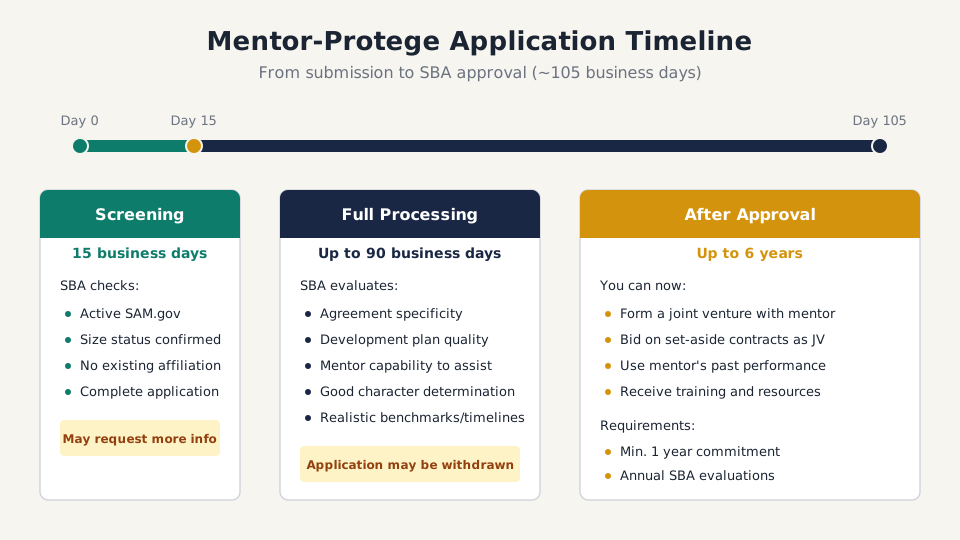
Here’s what the application requires:
-
A written mentor-protege agreement. This is the core document. It must detail what assistance the mentor will provide, include specific timetables and benchmarks, and explain how the protege will develop new capabilities. Vague promises don’t cut it. The SBA wants to see “Mentor will provide proposal writing training in Q1 and Q2, covering sections L and M, with protege independently drafting a proposal by Q3.” Not “Mentor will help protege with business development.”
-
Business information for both parties. NAICS codes, size certifications, existing contracts, financial statements, and organizational charts.
-
A development plan. What specific capabilities will the protege develop? What does the protege look like at the end of the agreement versus today?
Timeline: The SBA screens applications within 15 business days. If it passes screening, full processing takes up to 90 days. Total: roughly 105 business days from submission to approval (or denial). Plan accordingly — if you want to JV on a specific opportunity, start the application months before the solicitation drops.
The joint venture rules
Once you have an approved mentor-protege agreement, you can form a joint venture. The JV rules matter because they determine how work and money flow.
- The protege must own at least 51% of the JV. This isn’t just a paper requirement. The protege has to be the managing venturer — meaning the protege’s people run the day-to-day operations.
- The protege must perform at least 40% of the work. The mentor can do up to 60%, but the point is to build the protege’s capabilities, not let the mentor do everything under a small business label.
- The JV can use the mentor’s past performance. This is the headline benefit. But agencies can still require the protege to demonstrate some past performance at a reduced level. For example, if other bidders need five contracts worth $20 million each, the protege might only need to show one or two contracts worth $8-$10 million.
- The JV files a separate proposal. It’s a distinct entity bidding on the contract. Both partners contribute to the proposal, but it’s submitted under the JV’s name.
Plain English: the 40/60 work split
If the JV wins a $1 million contract, the protege’s team has to perform at least $400,000 worth of the work. The mentor can handle up to $600,000. This isn’t about dollars paid — it’s about who does the work. The SBA checks this during annual reviews. If the mentor is doing 90% of the work and the protege is just providing the small business label, the SBA will terminate the agreement.
How long the agreement lasts
A mentor-protege agreement can last up to six years. You have to maintain the relationship for at least one year after SBA approval. The SBA conducts annual evaluations to check whether the protege is actually benefiting.
During those annual reviews, the SBA looks at:
- What assistance did the mentor provide this year?
- What new capabilities did the protege develop?
- Did the JV win any contracts? How did performance go?
- Is the protege growing toward independence?
If the SBA determines the protege isn’t benefiting, it can terminate the agreement. If everything is going well, you can renew annually up to the six-year maximum.
After the agreement ends, the protege keeps all the past performance, capabilities, and relationships built during the program. That’s the endgame — you graduate from the program as a stronger, more competitive business that can bid prime on its own.
Common mistakes to avoid
Picking a mentor just because they’re big. Size doesn’t equal fit. The best mentor is a company working in your NAICS codes, on the same types of contracts you want to win, who has a real interest in developing your capabilities. A $2 billion defense contractor mentoring a 5-person marketing firm makes no sense, and the SBA will see through it.
Writing a vague agreement. “Mentor will assist protege with business development” will get your application kicked back. Be specific about what training, resources, and support the mentor will provide, with dates and milestones.
Treating it as a label instead of a relationship. Some businesses see the mentor-protege program as a vehicle to slap a small business sticker on a large company’s bid. The SBA knows this happens, and they actively police it. If the protege isn’t meaningfully participating in the JV’s work, the SBA will terminate the agreement and may refer the matter for investigation.
Waiting too long to apply. The 105-day processing timeline means you can’t start the application when you see an opportunity on SAM.gov. By the time you’re approved, the solicitation has closed. Start the process when you’ve identified a mentor relationship, not when you’ve found a specific contract.
Ignoring flow-down clauses. Even in a JV where you’re the managing venturer, federal compliance obligations flow through the contract. Make sure you understand what you’re signing up for, especially around cybersecurity (CMMC), cost accounting, and reporting requirements.
Mentor-Protege vs other agency programs
The SBA’s program is the biggest and most flexible, but it’s not the only one. The Department of Defense, DHS, DOE, and several other agencies run their own mentor-protege programs with different rules and benefits.
The key difference: only the SBA program provides the affiliation exemption for joint ventures. Agency-specific programs may offer other benefits (like reimbursement of mentor costs or evaluation credits), but they don’t automatically let you form a JV that competes as a small business on set-asides.
If your work is heavily concentrated in one agency, check whether that agency has its own program. You can participate in both the SBA program and an agency program simultaneously. The DOD program, for example, reimburses mentors for developmental costs — which can make it easier to find a willing mentor.
Your next steps
If you’re a subcontractor ready to move toward prime contracting, here’s the sequence:
- Identify a potential mentor. Look at the primes you’ve already subcontracted for. The best mentor-protege relationships grow from existing working relationships where both sides already know each other’s capabilities.
- Check the SBA’s active agreements list to see who’s already in the program and learn from their structure.
- Talk to your local APEX Accelerator (formerly PTAC). They help businesses draft mentor-protege agreements and navigate the application for free.
- Draft the agreement together with specific milestones, timelines, and a development plan that shows the SBA you’re serious.
- Apply through certify.sba.gov and plan for 105 business days of processing.
The subcontracting vs prime contracting comparison lays out the full picture of when you’re ready to make the jump. The Mentor-Protege Program is the bridge between the two — it lets you compete at the prime level while you’re still building the track record to do it solo.