SDVOSB certification guide: VetCert requirements, application, and renewal
SDVOSB certification lets a service-disabled veteran-owned business compete for federal set-aside and sole-source contracts, but only if SBA certifies the firm through VetCert. In 2026, that means at least 51% service-disabled veteran ownership and control, small-business status under at least one NAICS code in your SAM.gov profile, and company documents that prove the veteran actually runs the business. In FY2024, agencies awarded SDVOSBs $32.8 billion, so this is a real contracting lane, not a vanity badge.
If you’re still deciding whether veteran certification is your best move, start with the set-aside certifications guide. This article is for the owner who already knows SDVOSB is the target and wants the nuts-and-bolts version.
What SDVOSB certification actually gets you
Plain English: what VetCert buys you
VetCert is the SBA’s gatekeeper for SDVOSB work. Once you’re certified, your firm can compete for SDVOSB set-asides across the federal government and can receive sole-source awards up to $5 million for most contracts and $8.5 million for manufacturing.
The federal goal is now 5% of all contracting dollars to SDVOSBs. In FY2024 the government beat that mark, hitting 5.14% or $32.8 billion. That matters for one reason. Contracting officers are under pressure to keep that number up. When an agency needs qualified firms in your category, a certified SDVOSB moves to the front of the line faster than a general small business.
This also killed the old “just self-certify in SAM” mindset. For federal SDVOSB set-asides and sole-source awards, the certification requirement is real. SBA’s veteran contracting page says the one-year self-certification grace period ended on December 31, 2023 for those awards, and the FY2024 NDAA also required VetCert for subcontracting and goaling credit by December 22, 2024. If a consultant is still selling you on the old checkbox approach, the consultant is the one who is outdated.
Who qualifies in 2026
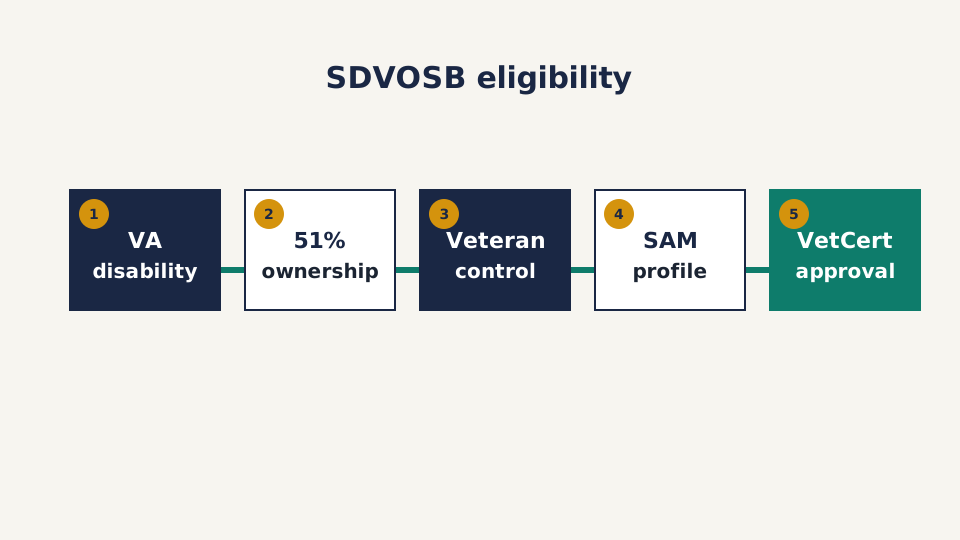
SBA’s baseline test is straightforward on paper.
- One or more service-disabled veterans must own at least 51% of the business.
- That same veteran group has to control the company, not just hold the shares.
- The business has to qualify as small under at least one NAICS code listed in SAM.gov.
- The veteran has to be recognized by VA as service-disabled.
Where people get burned is the word “control.”
SBA does not mean “the veteran is respected by everyone.” It means the veteran controls day-to-day operations and long-term decisions. If your operating agreement gives a non-veteran partner veto power, if the veteran is not really the highest officer, or if compensation and titles tell a different story than your application, expect questions.
There are two important exceptions. If the service-disabled veteran is permanently and totally disabled and cannot manage daily operations, the spouse or an appointed permanent caregiver can fill that management role. A surviving spouse can also keep the business eligible in certain circumstances after the veteran’s death. Those cases are real, but they trigger extra documentation, so do not treat them as casual workarounds.
What to gather before you log in
The public SBA material on VetCert is much more document-specific than most blog posts make it sound. The April 2024 preparation sheet says the program no longer requires five years of tax returns and W-2s. The core review is about ownership, control, and whether your business records all tell the same story.
For most applicants, that means:
- Active SAM.gov registration with a UEI and NAICS codes that match the work you do
- Articles of organization or incorporation, plus every amendment
- Operating agreement or bylaws, signed and dated
- Meeting minutes or written actions showing current officers and how the company actually operates
- Shareholder agreements and the latest stock ledger if you’re a corporation
- Partnership agreement if you’re a partnership
- A trust agreement if ownership runs through a trust
- A written explanation if the veteran is not the highest-paid person in the business
- A franchise agreement if you operate under one
- A letter explaining delinquent taxes, liens, or federally backed loan issues if those exist
- A letter of non-objection if an owner or household family member is a federal employee at GS-13 or above
Two practical points most people miss:
First, if someone else is preparing the application for you, SBA wants the consultant or contractor agreement uploaded with the file. Second, your personal details have to line up with VA records. SBA’s own prep sheet warns that name, date of birth, and home address mismatches between your application and your VA profile can stall the validation step before the reviewer even gets to the ownership documents.
And no, a capability statement is not required to apply. Build one anyway before you start chasing agencies. The capability statement template will save you time once the certification is active.
How the application and renewal process work now
The application path is simpler than it used to be:
- Create or log into MySBA Certifications.
- Claim your business.
- Complete the VetCert application and upload the ownership and control documents that fit your entity type.
- Respond quickly if SBA asks follow-up questions.
- After approval, keep the certification current and report changes.
SBA’s FY2024 SDVOSB factsheet reported an average 17-day time to decision and a 96% approval rate for fully processed cases. I would treat that as best-case speed, not a promise. Clean files move faster. Messy ownership records sit.
The certification term is three years. Renewal now runs through MySBA Certifications too, and SBA says firms can renew within the 90-day window before the end of the eligibility period. If you were already certified when SBA issued its May 13, 2025 program update, the agency granted a six-month extension and aligned renewal notices to that extended date. One side effect of that change: SBA removed the public expiration-date field from Small Business Search, so do not assume the absence of a visible expiration date means your file is permanent.
Approval is not the finish line. SBA’s March 2026 guidance repeats two ongoing obligations that matter:
- You must report changes that could affect eligibility within 30 calendar days.
- You must respond to program examinations if SBA opens one.
That second point is not theoretical. SBA’s FY2024 SDVOSB factsheet says the agency started a post-certification risk program with desk examinations and site visits. Treat the certification like a live compliance status, not a badge you frame and forget.
Where applications usually get stuck
In my experience, the hard part is not proving you served. The hard part is proving your company documents say the same thing your application says.
These are the common trouble spots:
- The veteran is listed as the owner, but the operating agreement gives real blocking rights to someone else.
- SAM.gov, state filings, stock records, and meeting minutes show different ownership percentages or officer titles.
- The veteran works full time somewhere else, which makes the “daily control” claim look shaky.
- The business uses a trust or family structure that the owners never cleaned up on paper.
- The applicant assumes old self-certification rules still apply and shows up unprepared for a real file review.
If any of those sound familiar, get help before you submit. Your local APEX Accelerator or Veterans Business Outreach Center is a better first call than a random certification consultant charging you to upload PDFs.
Is it worth it?
If you are eligible, yes. The market is too large to ignore, and the goal pressure is finally moving in the right direction for veteran-owned firms.
But the certification only pays off if it sits on top of a real capture plan. That means an active SAM.gov registration, a tight capability statement, a usable NAICS list, and a shortlist of agencies or primes that actually buy what you sell. If you want to pursue larger work after approval, the SBA Mentor-Protege Program and joint ventures vs. teaming agreements guide should be your next reads.
Your next move is simple. Pull your entity documents, log into VA.gov and confirm your personal profile matches exactly, then start the MySBA application. The firms that get delayed are usually not the ones that fail eligibility. They are the ones that submit a messy paper trail.
Sources
- SBA veteran contracting assistance programs
- SBA VetCert public portal
- Preparing for SBA Veteran Small Business Certification/Recertification fact sheet (April 2024)
- FY2024 SDVOSB prime contracting factsheet
- SBA memo: six-month extension for VOSB and SDVOSB participants
- SBA memo: veteran certification renewal moved into MySBA Certifications
- Federal Register final rule for VOSB and SDVOSB certification
- FAR 19.1406 sole source awards