8(a) certification guide: requirements, application, and what changed in 2026
Updated March 27, 2026. On January 22, 2026, SBA issued formal 8(a) Program Mandate guidance saying the program will be administered race-neutrally and that the agency will not use the 2023 “Guide for Demonstrating Social Disadvantage” while it finalizes new regulations. Some SBA pages still reflect the older workflow, so confirm the current evidence standard with your district office or an APEX Accelerator before you submit.
8(a) certification is still the strongest set-aside in federal contracting, but it is not the same program it was two years ago. To qualify in 2026, your business still needs to be small, at least 51% owned and controlled by a disadvantaged U.S. citizen, under the SBA’s economic thresholds, and established enough to show “potential for success.” The catch is that SBA scrutiny is clearly up, and sloppy applications are getting punished harder than before.
If you’re still deciding whether 8(a) is even the right target, read the set-aside certifications guide first. This article assumes you’ve already landed on 8(a) and want the nuts-and-bolts version.
Why 8(a) still matters
The SBA calls 8(a) a nine-year business development program, not just a certification. That distinction matters. You are not only getting access to competitive 8(a) set-asides. You are also getting access to sole-source awards up to $4.5 million for most contracts and $7 million for manufacturing, plus a Business Opportunity Specialist, SBA training, and access to the Mentor-Protege Program.
That is why people chase it. A normal small business certification helps you compete. 8(a) can change the size of contracts you can realistically pursue.
Plain English: what 8(a) buys you
Most certifications make the bidder pool smaller. 8(a) does that too, but it also lets an agency award certain contracts to you without full competition. That is the part consultants fixate on, and for once they are not wrong.
What changed in 2026
This is the part older guides keep missing.
In January 2026, SBA issued formal guidance saying it no longer treats anyone as socially disadvantaged simply because they belong to a particular minority group, and it removed the old “Guide for Demonstrating Social Disadvantage” from its site. A week later, SBA said it had suspended more than 1,000 8(a) firms for failing to provide requested documents. On March 4, 2026, the agency said it had started termination proceedings against 628 more firms that still had not complied.
My read, based on those SBA updates: 8(a) is still alive, but the application and compliance environment is less forgiving than it was in 2024. Expect more document scrutiny, more follow-up, and less hand-holding from the agency.
If you qualify on paper, that should not scare you off. It should change how carefully you prepare the file.
Who actually qualifies
Here is the current SBA baseline for individually owned firms:
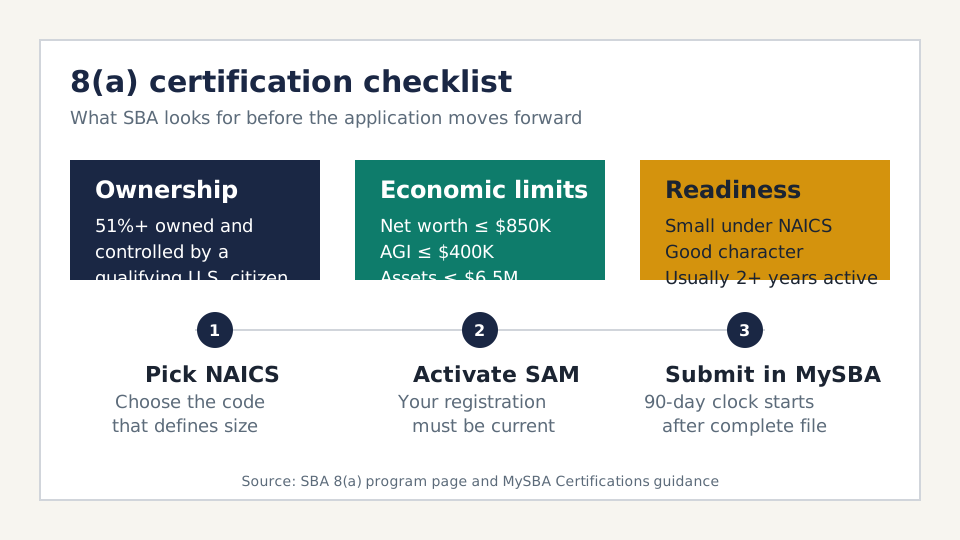
- Your business must qualify as small under the NAICS code you plan to use.
- The company cannot have previously participated in 8(a).
- One or more U.S. citizens must own and control at least 51% of the business.
- The qualifying owner must meet the economic disadvantage limits: personal net worth of $850,000 or less, adjusted gross income of $400,000 or less, and total assets of $6.5 million or less.
- You must show good character.
- You must show potential for success, which usually means at least two years in business.
There is one more piece, and it is the hardest one to write about cleanly in 2026: social disadvantage.
The official 8(a) page still says the business must be owned and controlled by people who are socially and economically disadvantaged. At the same time, SBA’s January 22, 2026 guidance says the agency will not admit firms based only on minority status or unsubstantiated discrimination narratives. So the practical takeaway is simple: do not assume a demographic category will carry you. Build a factual application that can survive review on its own merits.
If that sounds vague, it is. That is exactly why I would involve your local APEX Accelerator before you submit. Free review from someone who sees these applications every week is a much better move than guessing what the current reviewer wants.
What documents you need before you log in
The official SBA application runs through MySBA Certifications, and the agency points applicants to its Knowledge Base and Application Tips guide before starting. That is a hint worth taking.
At a minimum, expect to gather:
- Formation documents: articles, operating agreement or bylaws, stock records if applicable, and any amendments
- Three years of business tax returns and related schedules
- Personal tax returns and income records for the qualifying owner
- Documents supporting ownership, control, debts, transfers, and any unusual financial arrangements
- A resume and business-plan material showing staffing, contracts, and growth goals
- Any explanatory documents for prior legal issues, payment plans, ownership changes, or other complications
The easiest way to blow up an 8(a) application is with messy paperwork, not with a bad business. Missing signatures, incomplete tax returns, and ownership records that do not match across documents will send you back into the queue.
One useful detail from SBA’s certifications portal: a capability statement is not required to apply. Build one anyway before you start bidding. The capability statement template will make that part easier.
How the application process works
SBA’s current process is straightforward on paper:
- Identify your primary NAICS code.
- Make sure your SAM.gov registration is active.
- Start the 8(a) application in MySBA Certifications.
Applications are electronic. If SBA decides the file is incomplete, it notifies you through the portal. Once SBA decides the application is complete, the agency says it has 90 days to make a decision.
That does not mean you will be approved in 90 days from the day you first log in. It means 90 days from the day SBA accepts the package as complete. Big difference.
The ongoing obligations people underestimate
8(a) lasts up to nine years, split into a four-year developmental stage and a five-year transitional stage. It is also one-time-only for individuals. You do not get to cycle out, regroup, and do it again later.
More important, approval is not the finish line. SBA requires annual certification that you still meet the program requirements, and participants must submit annual review material to their servicing district office. That annual review can include tax returns, staffing documents, contract worksheets, marketing plans, and capability statements.
If your business is not ready for that level of ongoing administration, be honest about it now. 8(a) is powerful, but it is not a low-maintenance badge.
When 8(a) is worth it
In my experience, 8(a) makes the most sense for businesses that already have some traction and are ready to push into prime work. Maybe you have commercial revenue. Maybe you have state or local contract past performance. Maybe you have federal subcontracting experience and want access to joint ventures and mentor-protege structures that can move you up a weight class.
It is usually a bad fit for businesses that are still trying to finish basic setup. If your SAM registration is not active, your bookkeeping is sloppy, or you cannot explain your ownership and control structure in one clean paragraph, fix that first. 8(a) adds leverage, but it also magnifies disorder.
The smartest next step
Before you submit anything, run the SBA eligibility questionnaire, then book time with your local APEX Accelerator. Have them review your ownership documents, your tax returns, and your explanation of why you qualify. Then use the SBA Knowledge Base to work from the current checklist instead of an old consultant PDF.
If you get approved, the next move is not celebrating. It is building a list of agencies, NAICS-aligned opportunities, and potential mentor-protege partners before your first year disappears.