Capture management lifecycle for government contracts
Capture management is everything you do before you write the proposal. In government contracting, it starts when you spot a likely requirement and ends when you hand a qualified opportunity to the proposal team with a win plan, customer notes, teammate commitments, and a real bid decision. If you start working only when the RFP hits SAM.gov, you are not doing capture. You are doing catch-up.
That timing problem matters because the government starts earlier than most first-time bidders realize. FAR Part 7 says agencies perform acquisition planning for all acquisitions, and FAR Part 10 ties that planning to market research. By the time the solicitation shows up, the agency may already have done forecasts, requests for information, sources sought notices, one-on-ones, and internal planning. The businesses that show up during that window have a real shot at shaping the opportunity. The ones that wait for the final RFP usually spend 30 days writing against a year of someone else’s preparation.
The market is big enough to be worth that work. The SBA says small businesses received more than $183 billion in prime federal contracts in FY2024, or 28.8% of all federal contracting dollars. But that money does not go to firms that chase every random notice. It goes to firms that pick targets early and stay on them.
Plain English translation
Capture management is pre-proposal sales work for a government contract. You find a target, decide if it is worth pursuing, learn what the agency actually cares about, line up partners, and only then write the proposal. The proposal is the last step, not the first.
Why capture starts before the RFP
FAR 15.201 is blunt about this: exchanges with industry are encouraged from the earliest identification of a requirement through receipt of proposals. It specifically lists industry days, one-on-one meetings, draft RFPs, requests for information, presolicitation notices, and site visits. In plain English, talking to the agency before the formal Q&A period is not shady. It is part of the system, as long as the rules are followed and no one gets nonpublic information.
That is why small businesses get hurt when they treat capture like big-company fluff. Capture is just disciplined early work. You can do it with a spreadsheet, a short target list, and a few hours a week. You do not need Deltek and a business development team of 12 to do the basics right.
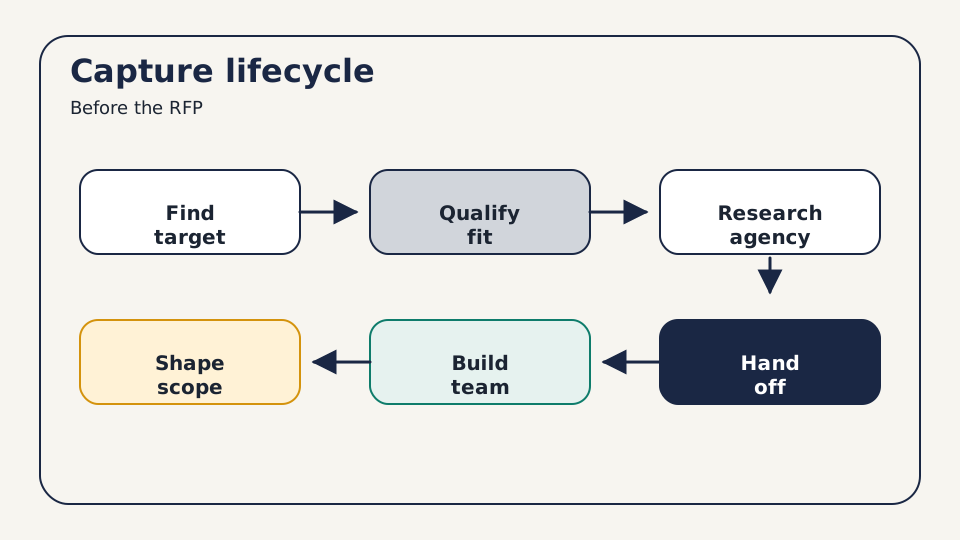
The six stages of the lifecycle
1. Target identification
Start with places where future work is visible. Check Agency Recurring Procurement Forecasts, SAM.gov Contract Opportunities, and USASpending.gov. If you want the easiest starting point, build a list of contracts expiring in the next 12 to 24 months using our guide on how to find expiring government contracts.
The point is not to build a giant pipeline. The point is to build a narrow one. Two agencies, one or two NAICS codes, and a short list of contracts you can actually win beats 200 saved searches you never touch.
2. Qualification
This is the bid or no-bid screen. Ask a few hard questions early. Can we do the work? Do we have relevant past performance? Is there a contract vehicle we can access? Is this likely to be a small-business set-aside, full and open, or better pursued as a subcontractor? If the honest answer is “not yet,” skip it or reposition yourself. That is not defeat. That is pipeline discipline.
Most small businesses do the opposite. They fall in love with the size of the contract, ignore the fit, and burn 60 hours on a bid they were never built to win.
3. Customer and incumbent research
Now figure out what problem the agency is actually trying to solve. Read the incumbent contract if you can find it. Look at modifications, option years, and place of performance. Pull similar solicitations. Read the agency mission page and procurement forecast entry. Search for sources sought notices and requests for information tied to the requirement. If one appears, respond. Our sources sought guide walks through how.
This is also where you learn whether the agency cares most about speed, transition risk, security clearances, field staffing, or price. Those are not interchangeable. A capture plan that misses the agency’s actual pain point is just paperwork.
4. Shaping the opportunity
This is the part people are afraid to do, and it is usually where the biggest edge lives. If the agency holds an industry day, go. If it asks for feedback on a draft statement of work, give useful feedback. If a small business office or contracting team is open to a capability briefing, take the meeting and show up prepared with a tight capability statement.
Good shaping is not lobbying and it is not magic. It is telling the agency, early and clearly, what contract structure makes sense, what requirements are unrealistic, what transition risk they are underestimating, and where small businesses can perform well. If your feedback helps the contracting officer write a cleaner solicitation, they remember you for the right reason.
5. Teaming and win strategy
Once the opportunity looks real, decide what your win path actually is. Are you the prime, or do you need a partner? Do you need a subcontractor with a clearance, a local presence, or a past performance credential you do not have? If yes, solve that before the RFP, not three days before questions are due.
At this stage, you should have a basic win plan: the customer problem, your discriminators, likely competitors, partner roles, and the proof points you will use in the proposal. Your past performance reference template should already be filled out. If you wait until proposal week to collect reference data, teammate letters, and staffing assumptions, capture has already failed.
6. Proposal handoff
A good capture handoff does not say, “Here is the solicitation, good luck.” It gives the proposal team a starting position.
That handoff package should include:
- The bid or no-bid decision and why
- Customer notes, incumbent intelligence, and any feedback from requests for information or industry days
- Confirmed teaming roles and contact points
- Draft win themes, major risks, and questions that still need answers
From there, the proposal team can use the government bid proposal template to build volumes around facts instead of guesswork.
Start with one live opportunity
Use how to find expiring government contracts to pick a target, then keep how to read a government solicitation open when the draft or final RFP lands.
What small businesses get wrong
The biggest mistake is confusing activity with progress. Saving notices is not capture. Sending the same capability statement to 40 agencies is not capture. Reading the RFP for the first time on the day it posts is definitely not capture.
The second mistake is refusing to kill weak pursuits. A no-bid decision is a win when it saves your time for a target you can actually shape and price. The firms that get better at government contracting are not the firms that bid everything. They are the firms that get ruthless about fit.
The third mistake is treating capture and proposal as separate worlds. They are connected. Capture decides whether the opportunity is winnable. Proposal proves it on paper. If capture does sloppy work, proposal cannot rescue it with clever writing.
Your next move
This week, build one capture sheet for one real opportunity. Start with a target agency, the incumbent contract number, likely contract vehicle, set-aside guess, top customer pain point, and a hard yes or no on whether you can win. Then track the next signal: a forecast entry, a sources sought notice, a draft RFP, or an industry day.
That is the capture management lifecycle in practice. Not theory. Not buzzwords. Just doing the work before everyone else realizes the work has started.