How to use agency procurement forecasts to find contracts before the RFP
The fastest way to find federal contracts before they hit SAM.gov is to start with agency procurement forecasts, then validate each lead with award history and buying-office context. Forecasts tell you what an agency expects to buy, roughly when it expects to buy it, and often whether the work may be set aside for small business. They are not promises. They are early warning.
That distinction matters. SBA tells small businesses that every agency publishes a procurement forecast, and the same SBA page warns that some businesses spend $80,000 to $130,000 landing their first federal contract and may wait up to two years to see a return. If your capture process starts only when the RFP drops, you burn time late and burn money early.
What a procurement forecast actually gives you
Think of a forecast as the government’s rough draft of a buying plan. On Acquisition.gov’s procurement forecast hub, you can jump to agency forecast pages, small business pages, vendor communication plans, and industry liaison directories from one place. That matters because a forecast by itself is just a lead. The supporting pages tell you who buys, who helps small businesses, and how the agency wants vendors to communicate.
The more useful version is the forecast of contracting opportunities tool on Acquisition Gateway. GSA says the tool gives vendors a centralized view of agency forecasts with standardized data elements, and that vendors can filter by agency, organization, place of performance, NAICS code, estimated award date, acquisition strategy, contract type, and award status. That is enough information to build a real pursuit list instead of a wish list.
Plain English: a forecast is radar, not an RFP
A forecast means “this office expects to buy something like this.” It does not mean the solicitation is guaranteed, the scope is final, or the set-aside decision is locked. GSA says forecast entries are for planning purposes only and can be revised or cancelled. Treat them as an early signal, then do the homework.
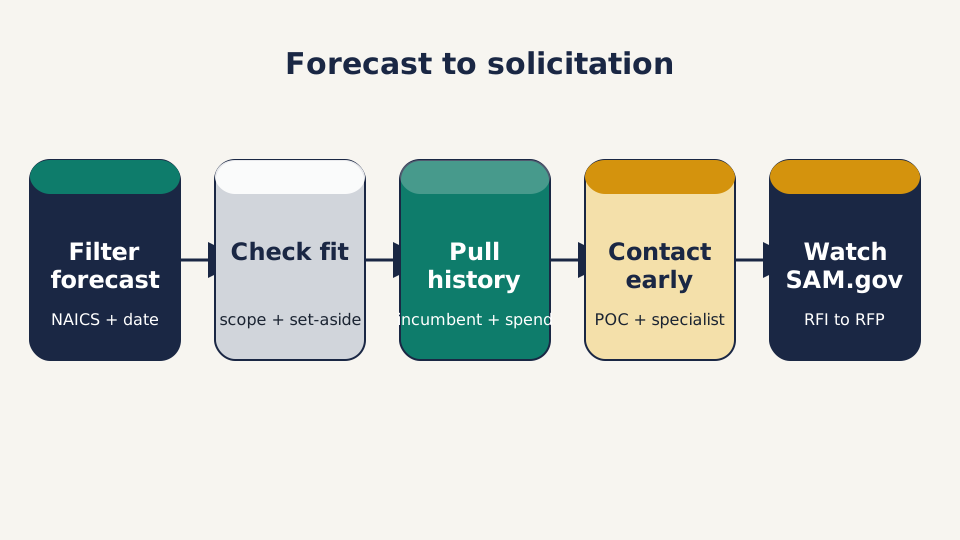
Where to look first
Start with the federal hub, not 24 agency bookmarks.
Acquisition.gov’s Agency Recurring Procurement Forecasts page was updated on April 6, 2026 and links directly to forecast pages across civilian and defense agencies. If you are still early in government contracting, that page is the cleanest way to see which agencies even publish the kind of information you need.
From there, move into the agency-specific tool. For example, DOT says it publishes its annual procurement forecast by October 1 and maintains it as a searchable database by quarter, industry category, operating administration, and keyword. That is how you want to think about forecasts in general: not as a static PDF, but as a live screening tool.
One more point that most beginners miss: FAR 15.201 encourages exchanges with industry from the earliest identification of a requirement through receipt of proposals. In other words, the pre-RFP window is real. Forecasts matter because they tell you where that window might open next.
The six forecast fields that matter
Not every data field deserves equal attention. These six do.
| Field | Why it matters |
|---|---|
| NAICS code | If the buying office tags the requirement to a NAICS code outside your lane, move on. A pretty title does not beat a bad NAICS fit. |
| Estimated award date | This tells you whether the opportunity is worth capture work now, later, or never. A target with an estimated award six months out is different from one slipping into next fiscal year. |
| Acquisition strategy / set-aside | GSA notes the filter can show set-aside type when available. This is one of the fastest ways to separate a realistic small-business target from a vanity target. |
| Contract type | Firm-fixed-price, task order, BPA call, GWAC task, schedule order. The vehicle tells you how the work will actually move. |
| Place of performance | A contract you can perform remotely is a different animal than one needing cleared staff in Huntsville next quarter. |
| Point of contact | The FCO tool includes a POC on each opportunity. That turns a record into a conversation, which is the whole point of getting there early. |
If a forecast entry is missing half of those fields, do not toss it automatically. Just score it lower. Forecasts are imperfect by design. You are looking for directional accuracy, not courtroom evidence.
How to turn a forecast entry into a real capture target
This is where most firms get lazy. They find a forecast entry, dump it into a spreadsheet, and call that pipeline. It is not pipeline until you do the next four moves.
1. Check whether the fit is real
Start with your own business. Does the NAICS code match your SAM.gov registration? Do you have past performance anywhere close to the scope? If the opportunity looks prime-only and you are still building your first references, you may be better off chasing it as a subcontractor instead.
This is where discipline saves you. The SBA’s own warning about first-contract cost and timeline should kill the fantasy that you can pursue everything. You cannot. Pick the entries you can actually shape.
2. Pull the award history
A forecast tells you what might happen. USASpending.gov tells you what already happened. Search the buying office, the likely NAICS code, and the incumbent contractor. If this smells like a recompete, work through our guide on how to find expiring government contracts and figure out the current contract number, period of performance, value, and place of performance.
If the office has never bought this work before, that is useful too. It may mean a brand-new requirement, or it may mean the work is currently buried inside another vehicle. Either way, you have more context than the vendor who stops at the forecast title.
3. Find the small business angle early
The best forecast entries are not just relevant. They are winnable.
If the acquisition strategy points to a small-business set-aside, great. If it does not, that is not the end of the story. Forecasts are planning tools. GSA explicitly says final competition and small-business decisions are made only if and when the solicitation posts on SAM.gov. That means the set-aside decision may still move based on market research, industry responses, and agency planning.
That is why FAR 15.201 matters here. Agencies are encouraged to use early exchanges, RFIs, industry days, one-on-ones, draft RFPs, and small business conferences. If your firm is a credible fit, the pre-RFP window is when you make that case.
4. Email the POC like a normal human being
GSA says each FCO opportunity includes a point of contact and encourages small businesses to include the opportunity’s small business specialist on correspondence. Do that. Keep the email short. Reference the forecast entry, the buying office, your exact fit, and one reason the agency should care.
Bad email: “Please keep us in mind for future opportunities.”
Better email: “I saw the forecast entry for cybersecurity support under NAICS 541519 with an estimated FY26 award. My firm supports Level 1 and Level 2 help desk and vulnerability management for two state agencies today. We can perform in Colorado and New Mexico, and we would appreciate a short call on whether the requirement is expected to be small-business set aside.”
That email sounds like you read the record and understand your lane. Which is rare.
Best companion guide
If a forecast entry survives your first screen, open the capture management lifecycle guide next. Forecasts help you find the target. Capture work is what keeps you from chasing it blindly.
5. Watch for the handoff to the real notice
Forecasts do not win contracts. They buy you time before the real notice appears. Once the opportunity is on your radar, monitor for the next signal: a sources sought notice, an RFI, an industry day, a draft RFP, or the final solicitation.
By the time the final notice hits SAM.gov, you want four things already done: a capture sheet, a capability statement tailored to the work, a rough view of the incumbent situation, and a hard decision on whether you belong in the bid.
What beginners get wrong
The first mistake is treating forecasts like gospel. They are not. Dates slip. Scopes change. Set-aside plans move. Offices merge requirements. Good contractors know that and use forecasts anyway, because imperfect early data is still better than perfect late data.
The second mistake is filtering only by keywords. Keyword search is a trap. “Program management” can describe half the federal government. NAICS code, place of performance, organization, and acquisition strategy do the real work. Use keywords to find possibilities. Use the filters to cut them down.
The third mistake is waiting for SAM.gov before making contact. That is backwards. Once the solicitation posts, the contracting officer becomes the focal point and the room gets tighter. Before that, the rules are looser, the options are wider, and the agency is still learning what the market can do.
The fourth mistake is confusing volume with pipeline quality. Ten forecast entries you can actually pursue beat 200 records you never research. Every time.
Your next move
Open Acquisition.gov’s forecast hub, click into one agency that already buys what you sell, and pull five forecast entries into a sheet today. Then rank them by NAICS fit, estimated award date, likely set-aside path, and whether you can name the incumbent or buying office behind the requirement.
Do that once and you stop browsing notices like a tourist. You start building a capture list. That is the whole game before the RFP shows up.