Contract administration basics for small businesses: what to do after award
Contract administration is the work that starts the minute the award hits your inbox: figuring out who can direct you, translating the contract into daily tasks, invoicing correctly, documenting every change, and protecting your past performance. For a small business, the basics are simple. Read the awarded contract like an operator, not a salesperson; do not perform extra work without written authority from the contracting officer; and keep one clean paper trail for deliverables, invoices, and scope changes.
The hard part is that nobody warns you how fast small mistakes snowball after award. A vague kickoff note turns into rework. A helpful COR email turns into unpaid extra work. A rejected invoice turns into a cash-flow problem you created for yourself.
Still on the pre-award side? Start with how to read a government solicitation, then come back here once you have the award in hand. Contract administration gets much easier when you already understand Sections B, C, F, G, and H.
What contract administration actually covers
In plain English, contract administration means making sure the contract gets performed the way it was awarded. FAR Part 42 covers the government’s contract administration framework, and FAR Subpart 42.5 says postaward orientation exists to create a clear, mutual understanding of requirements and surface problems early.
That sounds abstract, so here is the practical version. Contract administration is your system for answering five questions every week:
- What exactly are we required to deliver?
- Who on the government side can tell us what to do?
- What changed, if anything?
- What do we need to invoice, and when?
- What record are we building for CPARS and closeout?
If you cannot answer those five questions quickly, the contract is already drifting.
Plain English: CO vs COR
The contracting officer can bind the government. The COR usually cannot. FAR 1.602-2 says a COR has no authority to make commitments or changes affecting price, quality, quantity, delivery, or other contract terms. FAR 1.604 says the COR assists with technical monitoring and administration. That is a big difference.
Sometimes there is also an administrative contracting officer, or ACO. FAR 42.202 allows the contracting officer to delegate contract administration functions to a contract administration office or ACO. If that happened on your award, the delegation will be in writing. Do not guess. Ask who handles mods, invoices, property, and closeout.
What to set up in your first week after award
Your first week is not about working harder. It is about building control before performance gets messy.
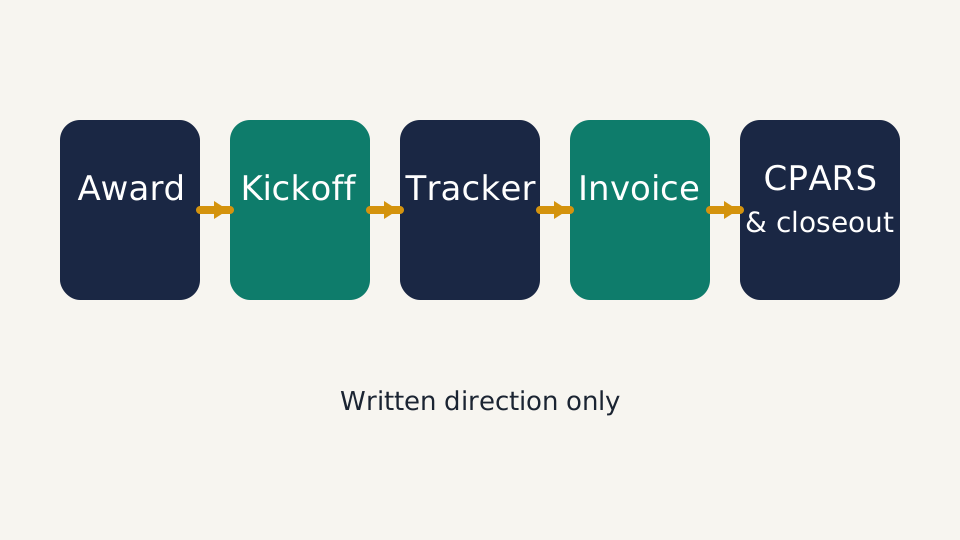
Read the award package backwards. Start with Section F for dates and place of performance, Section G for invoicing and admin contacts, Section H for special requirements, Section B for CLIN structure, and Section C or the PWS for the actual work. If you won off a task order or BPA call, read the order itself first, then the parent vehicle only where the order points you back upstream.
Get the kickoff or postaward orientation in writing. FAR 42.503-2 is blunt: a postaward conference is not supposed to change the contract, and any change that does result from the conference must be made by contract modification. That means your internal notes matter. After the kickoff, send a recap email listing deliverables, dates, reporting cadence, government points of contact, invoice routing, and open questions.
Build a one-page deliverable tracker. For each CLIN or deliverable, capture the due date, format, reviewer, acceptance standard, invoice trigger, and supporting backup. If the contract requires monthly reports, staffing rosters, travel approvals, equipment logs, or cybersecurity artifacts, track those too. A lot of payment problems are really documentation problems wearing a different shirt.
Confirm the systems before the first invoice is due. Some agencies use the Invoice Processing Platform. Some use PIEE/WAWF. Some still route through agency-specific finance workflows. Section G and the payment clause control this, not whatever somebody said on a call.
Lock down your subcontractor file early. If you are using subs, make sure your teaming promises match the awarded work, your subcontracts reflect the actual reporting and deliverable cadence, and the required clauses are handled. If you are a prime flowing work down, reread understanding flow-down clauses in subcontracts before the first handoff.
The rule that prevents the most expensive post-award mistake
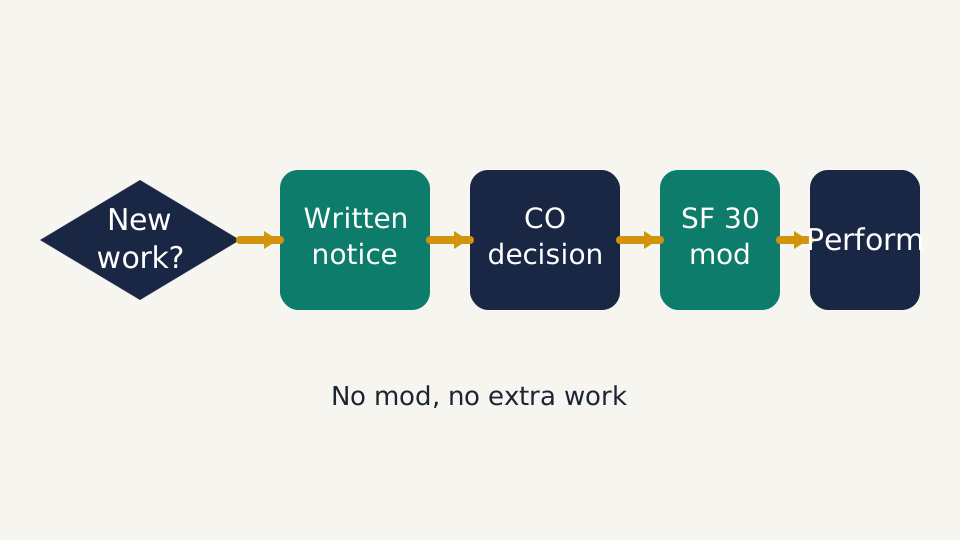
Here it is: if the government wants something materially different, get it in writing from the contracting officer before you treat it as contract work.
That sounds obvious. In practice, it is where small businesses get burned. A program office asks for “just one more slide.” The COR wants a report in a new format. A technical lead asks your team to sit in an extra weekly meeting, add a dashboard, or accelerate a milestone. None of that is harmless if it changes labor, schedule, or scope.
FAR 43.102 says only contracting officers acting within the scope of their authority can execute contract modifications on behalf of the government. FAR 43.103 splits modifications into two buckets: bilateral mods, which both sides sign, and unilateral mods, which only the contracting officer signs. FAR 43.202 says change orders come from the contracting officer unless that authority was delegated to an ACO.
So what do you do when someone asks for something outside the paper?
- Reply in writing the same day.
- State what changed: scope, quantity, format, period of performance, or delivery timing.
- Ask whether the government wants the request handled by modification.
- Do not let your team quietly absorb it while “we sort out the paperwork.”
FAR 43.104 also gives contractors a path when the government may have effected a change without identifying it as one in writing. Your job is not to pick a fight. Your job is to create a record while the facts are still clean.
If you spend time reading contractor forums, the same post keeps showing up in different words: “The COR told us to do it, finance rejected the invoice, and now nobody owns the extra work.” That is not bad luck. That is failed change control.
Invoicing: where good contractors look sloppy
A lot of first-time awardees think invoicing is a finance problem. It is not. It is a contract administration problem.
The Treasury IPP program gives vendors a way to submit invoices, check status, and receive payment details for enrolled agencies. The step-by-step IPP guidance updated on March 18, 2026 shows vendors now log in through ID.me or Login.gov before creating invoices against open purchase orders. If your agency uses IPP, get access sorted before the due date. Do not wait until the day cash is supposed to land.
The FAR payment clock is also more structured than many new contractors realize. FAR 32.904 says the due date for an invoice payment is generally the later of two events: 30 days after the billing office receives a proper invoice, or 30 days after government acceptance. That means a bad invoice package or unclear acceptance trail pushes your payment to the right.
Two habits fix most of this:
Invoice from the contract, not from memory. Use the exact CLIN numbers, units, dates, and backup the contract or kickoff instructions require. If the contract wants labor detail, attach it. If it wants deliverable acceptance before billing, do not skip the acceptance email. If it wants travel broken out, do that.
Treat invoice rejections like admin failures, not random bad luck. FAR 32.906 says if the billing office wrongly rejected a proper invoice, the original receipt date should still control once the invoice is resubmitted for purposes of the payment due date and any interest penalty. That protection helps only if your record is clean enough to prove what happened.
A simple rule: every invoice should have a matching packet. Contract reference, acceptance record, backup documentation, and the email or system receipt showing submission. One folder per invoice. No scavenger hunts later.
CPARS starts earlier than most small businesses think
Many owners think CPARS is a final report card at the end. Not quite.
FAR 42.1502 requires performance evaluations for contracts and orders above the simplified acquisition threshold. Acquisition.gov’s threshold update says that threshold increased from $250,000 to $350,000 effective October 1, 2025. If a modification pushes your contract over that line, the evaluation requirement can show up midstream.
FAR 42.1503 also says contractors get up to 14 calendar days to respond when an evaluation is ready for comment in CPARS. That response window matters, but it is not where you want to start building your case. By the time CPARS opens, the real facts were already created in your status reports, deliverable history, invoice trail, and email recaps.
If you want a strong CPARS outcome, do three things throughout performance:
- Send short written recaps after every meaningful decision.
- Document government acceptance, not just delivery.
- Flag risks early, with options, not excuses.
That last part matters. Contracting officers can forgive bad news faster than they forgive surprises.
Your small-business operating system for post-award control
You do not need enterprise software to administer a contract well. You need discipline.
Keep one award folder with the signed contract, mods, kickoff notes, contacts, and clauses you actually use. Maintain one live tracker for deliverables, invoices, and pending government actions. Create one change log so every request that touches scope, schedule, staffing, or format gets recorded the same day it appears.
And be specific about authority. If a COR gives technical feedback, great. If that feedback starts changing deliverables, dates, or level of effort, move the conversation to the CO before your team acts on it. The smallest sentence in the room can become the biggest unpaid cost on the contract.
If this award includes subcontractors, now is the time to get your admin house in order. Review small business subcontracting plan explained if you are a large prime with plan obligations, and use SBA Mentor-Protege program or joint ventures vs teaming agreements if the next contract will require a more formal delivery structure.
Your next move
Open the awarded contract and build a one-page admin sheet today. Put the CO, COR, invoice system, CLINs, deliverables, reporting dates, and mod process on one screen. Then send a kickoff recap email that confirms how direction, acceptance, and billing will work.
That is contract administration in real life. Not glamorous. Not optional. And a lot cheaper than doing extra work first and arguing about authority later.