SAM vs CAGE: understanding the relationship
SAM.gov and a CAGE code are not competing versions of the same thing. SAM.gov is the federal system where your entity registration lives. A CAGE code is the five-character identifier tied to the offeror location inside that system. You register in SAM.gov to get active. If you are a U.S. entity registering for contracts and do not already have a CAGE code, one is assigned as part of that process.
That distinction matters because a CAGE code by itself does not mean you are eligible to win work. What agencies care about is an active SAM registration with the right CAGE code attached to the right location.
Plain English: SAM vs CAGE
SAM.gov is the full registration record: your legal entity data, UEI, status, reps and certs, points of contact, and banking details. Your CAGE code is the location-level ID that contracting officers use to match that record to the exact business location making the offer.
What SAM.gov actually does
Think of SAM.gov as your master vendor record. It is where the government stores your legal business name, physical address, UEI, points of contact, representations and certifications, and active or expired registration status.
That is why “I have a CAGE code” is never the full answer. A contracting officer is not just looking for a code that exists somewhere in a database. They are checking whether your entity is active in SAM right now and whether the associated details line up.
The current SAM entity registration checklist shows how broad the system is. For a contracts registration, you are dealing with core data, assertions, reps and certs, and points of contact. SAM is the record that ties all of that together.
If you are still sorting out your registration from scratch, start with the complete guide to registering for government contracts. That is the big picture. This post is about one piece of it.
What a CAGE code actually does
A CAGE code is narrower. Under FAR Subpart 4.18, offerors provide the CAGE code assigned to the offeror’s location, and contracting officers verify it through SAM before award.
That “location” language is the part most people miss.
Your CAGE code is not just a nickname for your business. It is the identifier tied to the specific place that is offering or performing the work. If you run one small office and never move, that can feel like a meaningless technical detail. If you have multiple locations, changed addresses, or inherited an old registration record, it becomes a very real problem fast.
Here is the clean comparison:
| SAM.gov | CAGE code | |
|---|---|---|
| What it is | Federal registration and status record | Five-character location identifier |
| Managed by | GSA | Defense Logistics Agency |
| What it tells the government | Whether your entity is active and what data is on file | Which exact offeror location is tied to the record |
| When it comes up | Registration, renewal, reps and certs, payments | Offers, awards, contract records, DLA lookup |
| What happens if SAM expires | You are not eligible for new awards | The code may still exist, but it does not replace active registration |
If you want the full breakdown of what the code is and how it gets assigned, the CAGE code guide covers that piece in detail. If you are still mixing up UEI and CAGE, read What is a UEI? next.
How they connect in real life
The normal flow for a U.S. contractor is simple.
- You start or update your SAM.gov registration.
- SAM validates your entity data and status.
- If you do not already have a CAGE code tied to that location, one gets assigned during the process.
- Before award, the contracting officer checks SAM to confirm the registration is active and the associated CAGE code is verified.
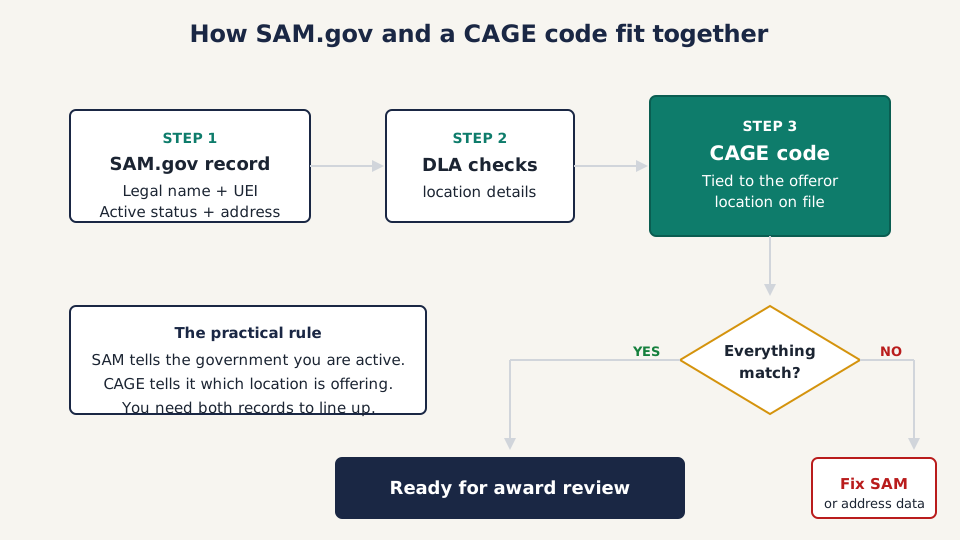
The same FAR section makes this explicit: active registrations in SAM have had their associated CAGE codes verified. That is why the relationship matters. SAM tells the government whether the entity is active. The CAGE code tells the government which exact location record goes with that entity.
This is also why stale address data causes so much pain. If your physical address changed but your registration did not, you are not dealing with a cosmetic typo. You are dealing with a mismatch between the offeror record and the location identifier attached to it.
Start here
If your registration is still in progress, use the registration guide. If your record is active but the expiration date is creeping up, use the SAM.gov renewal guide before you touch your next bid.
Three mistakes people make
“SAM and CAGE are interchangeable.” They are not. SAM is the system. CAGE is one identifier used inside that system.
“If I have a CAGE code, I must be active in SAM.” Not true. A code can exist while your registration is expired, incomplete, or tied to outdated address data. For new awards, the active SAM status is the part that keeps you eligible.
“One company always means one CAGE code forever.” Not necessarily. The CAGE side is tied to the offeror location. If you move, restructure, or operate out of multiple locations, this is where things stop being simple.
How to check both in five minutes
First, look up your entity in SAM.gov and confirm the status says “Active.” While you are there, verify the legal name, UEI, and physical address are all exactly what they should be.
Second, search your record in the DLA CAGE portal. Make sure the code, legal name, and address all point to the same real-world location you are using for contracting.
Third, compare whatever is in your proposal template, capability statement, or subcontractor forms against those records. This is where people get sloppy. They update the SAM profile but keep sending an old capability statement with an old address or an old CAGE code. That is how avoidable problems make it into a live bid.
Your next move is straightforward. Log into SAM.gov this week, verify your active status, and match your CAGE record to your current physical location. If those two records line up, you are in good shape. If they do not, fix them before your next offer, not the night a proposal is due.